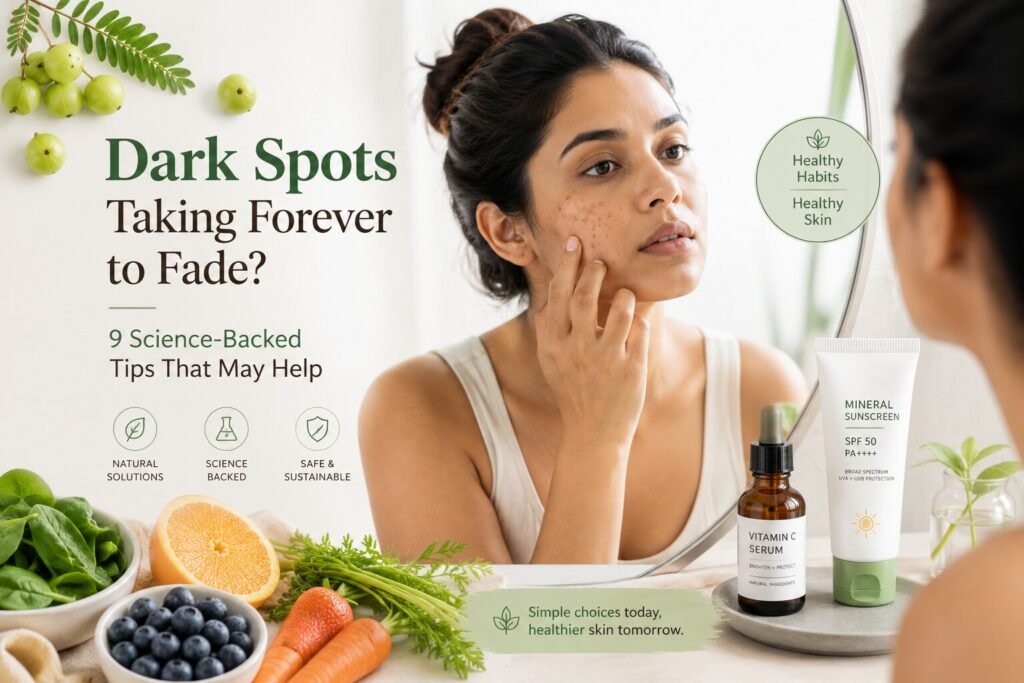
We’ve all been there. You finally get rid of that annoying pimple… only to be left with a dark mark that refuses to disappear. Weeks turn into months, and suddenly you’re Googling everything from DIY face masks to expensive laser treatments.
Sound familiar? The good news? Most dark spots do fade over time. The not-so-good news? They usually take longer than social media makes you believe. There isn’t a magical cream—or a kitchen ingredient—that erases pigmentation overnight.
Instead, improving hyperpigmentation is all about consistency, protecting your skin, and choosing remedies that are actually supported by evidence. In this guide, we’ll separate facts from internet myths and explore practical, science-backed tips that may help your skin recover naturally.
Why Do Dark Spots Take So Long to Fade?
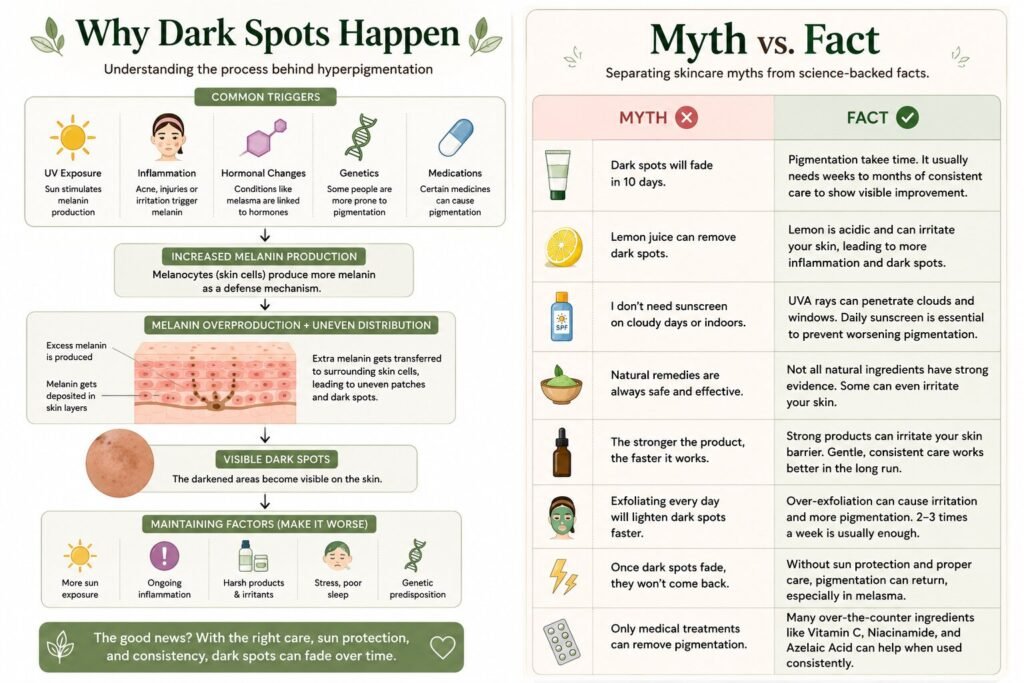
Dark spots, also known as hyperpigmentation, develop when certain areas of your skin produce extra melanin—the natural pigment responsible for your skin colour.
This can happen after:
- Acne breakouts
- Excessive sun exposure
- Hormonal changes (like melasma)
- Skin injuries or inflammation
- Certain medications
Unlike a surface stain, the extra pigment sits within the skin. Your body has to gradually remove it as your skin naturally renews itself—a process that can take weeks or even months, depending on how deep the pigmentation is and what’s causing it.
That’s why expecting visible results in just a few days often leads to disappointment.
What Actually Causes Hyperpigmentation?
There’s no single cause.
Dermatologists now understand that pigmentation is influenced by several overlapping factors, including:
- UV radiation from the sun
- Inflammation after acne or skin irritation
- Hormonal changes
- Genetics
- Oxidative stress within skin cells
One factor that has received growing attention is oxidative stress. When free radicals build up faster than your body’s natural antioxidant defences can handle them, they may contribute to inflammation and trigger excess melanin production—particularly in conditions like melasma.
Research published in the International Journal of Molecular Sciences suggests oxidative stress plays an important role in melasma, alongside hormonal and environmental factors.
The takeaway? Hyperpigmentation isn’t simply a “surface problem.” It’s often the result of multiple processes happening inside your skin.
1. Make Sun Protection Your Non-Negotiable Habit
If there’s one tip almost every dermatologist agrees on, it’s this:
No treatment will perform at its best if your skin isn’t protected from UV exposure. Even a few minutes of strong sunlight can stimulate melanin production, making existing dark spots darker and slowing down their fading process.
That doesn’t mean you need to stay indoors all day.
Instead:
- Wear a broad-spectrum SPF 30 or higher every day.
- Reapply sunscreen if you’re outdoors for extended periods.
- Use sunglasses, hats or an umbrella during peak afternoon sun.
- Don’t forget that UV rays can reach your skin even on cloudy days.
For people with melasma, dermatologists often recommend mineral sunscreens containing zinc oxide or titanium dioxide because they also help block visible light, which may worsen pigmentation in some individuals.
This simple habit often delivers better long-term results than constantly switching skincare products.
2. Fill Your Plate With Antioxidant-Rich Foods
While no food can erase pigmentation on its own, your diet does influence your skin’s overall health. A colourful plate packed with antioxidant-rich foods may help your body defend itself against oxidative stress—the same process linked to premature skin ageing and certain forms of pigmentation.
Some excellent choices include:
- Amla (Indian gooseberry)
- Berries
- Citrus fruits
- Spinach
- Beetroot
- Carrots
- Tomatoes
- Pomegranate
- Nuts and seeds
Amla deserves a special mention because it’s naturally rich in vitamin C and plant antioxidants. While you’ll often find claims that it can “cure” melasma, current research doesn’t support such dramatic promises. What it can do is contribute to a healthy, antioxidant-rich diet that supports overall skin function.
Think of these foods as giving your skin the nutrients it needs—not as miracle treatments.
3. Don’t Overdo Your Skincare Routine
Here’s something many people don’t realise. Sometimes, it’s not your pigmentation that’s getting worse—it’s your skin barrier that’s getting weaker.
Using too many products at once can lead to irritation, especially if you’re layering exfoliating acids, retinoids, scrubs and strong active ingredients without guidance. When your skin becomes irritated, inflammation increases. And inflammation can trigger post-inflammatory hyperpigmentation, especially in deeper skin tones.
Instead of chasing every trending serum:
- Stick to a gentle cleanser.
- Use a moisturiser that suits your skin.
- Apply sunscreen daily.
- Introduce new active ingredients slowly.
Your skin often responds better to consistency than complexity.
4. Some Natural Ingredients Show Promise—But Keep Expectations Realistic
Natural skincare has exploded in popularity, but “natural” doesn’t automatically mean effective. One ingredient that does stand out in scientific literature is licorice root extract (Mulethi).
Researchers have identified compounds such as glabridin and liquiritin, which may help reduce excess pigmentation by slowing melanin production and improving the appearance of uneven skin tone. Several studies have found licorice extract to be a promising complementary ingredient for hyperpigmentation, although it’s not considered a replacement for dermatologist-prescribed treatments.
On the other hand, popular DIY remedies like rice flour face packs have very little clinical evidence behind them. They may provide gentle exfoliation or leave your skin feeling smoother, but there’s currently insufficient research to conclude that they significantly reduce melasma or stubborn pigmentation.
The lesson?
Traditional remedies can certainly be part of a skincare routine—but it’s worth knowing which ones have scientific support and which ones are backed mainly by anecdotal experience.
5. Choose Ingredients That Dermatologists Actually Recommend
If you’re planning to invest in skincare, don’t get distracted by fancy packaging or viral trends. Look for ingredients that have consistently shown results in clinical studies.
Some of the most trusted options include:
Vitamin C
Vitamin C is one of the best-studied antioxidants in skincare. It helps neutralise free radicals, supports collagen production and can gradually improve the appearance of post-inflammatory hyperpigmentation with regular use.
It won’t erase dark spots overnight, but over several weeks, many people notice a brighter, more even complexion.
Niacinamide
Niacinamide (Vitamin B3) is another dermatologist favourite.
Instead of reducing melanin production directly, it helps slow the transfer of pigment to skin cells, making it particularly useful for uneven skin tone. It’s also gentle enough for most skin types and works well alongside Vitamin C.
Azelaic Acid
For people dealing with acne marks or melasma, azelaic acid is often recommended because it targets both inflammation and excess pigmentation. Many dermatologists consider it one of the safest options for long-term use, especially for sensitive skin.
Licorice Root Extract
As we discussed earlier, licorice extract is one of the few botanical ingredients backed by encouraging research. Products containing standardised licorice extract may help improve pigmentation when used consistently alongside sunscreen—not instead of it.
The takeaway?
You don’t need a shelf full of products. One or two well-formulated ingredients used consistently often outperform a complicated 10-step routine.
| Remedy | Evidence | Best For |
|---|---|---|
| Sunscreen | ⭐⭐⭐⭐⭐ | Preventing worsening pigmentation |
| Vitamin C | ⭐⭐⭐⭐☆ | Brightening, antioxidant support |
| Niacinamide | ⭐⭐⭐⭐☆ | Uneven skin tone |
| Licorice Extract | ⭐⭐⭐⭐☆ | Mild to moderate pigmentation |
| Rice Flour | ⭐⭐☆☆☆ | Gentle exfoliation |
| Multani Mitti | ⭐☆☆☆☆ | Oil control, not pigmentation treatment |
6. Give Your Skin Time to Heal
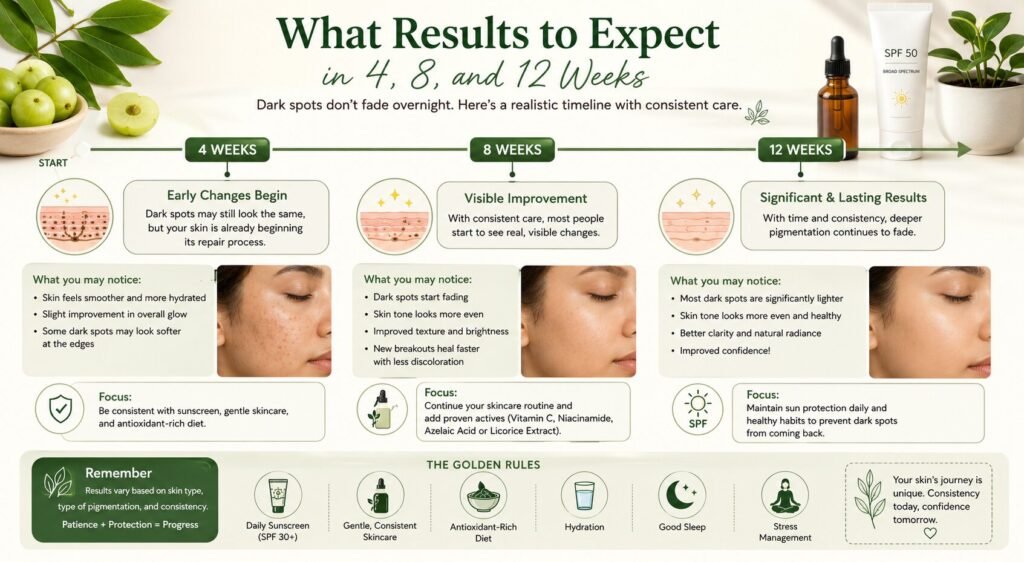
Here’s something social media rarely tells you. Skin renewal isn’t instant. Even if you’ve started using the “right” products, your skin still needs time to replace pigmented cells with new ones.
Depending on the cause, noticeable improvement can take:
- 4–8 weeks for mild post-acne marks.
- Several months for deeper pigmentation.
- Even longer for melasma, which has a tendency to return if the underlying triggers aren’t managed.
Switching products every two weeks is one of the biggest reasons people feel that “nothing works.” Instead, take progress photos once a month under the same lighting. The changes are often easier to spot than you think.
7. Stop These Common Habits That Can Make Dark Spots Worse
Sometimes, the biggest obstacle isn’t what you’re doing—it’s what you’re unknowingly doing wrong.
Picking at Pimples
We’ve all done it. But every time you squeeze or scratch a pimple, you’re increasing inflammation and raising the chances of post-inflammatory hyperpigmentation.
Skipping Sunscreen
Even the best brightening serum can’t compete with repeated UV exposure.
Using Too Many Actives
Combining strong acids, retinoids, scrubs and DIY treatments all at once may irritate your skin barrier, making pigmentation more stubborn instead of less.
Expecting Overnight Results
Hyperpigmentation isn’t a stain sitting on the surface. It’s a biological process. Treat it like one.
8. What About DIY Face Packs?
Pinterest and Instagram are full of homemade remedies. Some can feel soothing. Some simply smell nice. And a few may offer mild benefits.
For example:
- Aloe vera contains compounds that may support skin repair.
- Oatmeal can help calm irritated skin.
- Yogurt contains lactic acid, which gently exfoliates.
- Licorice has promising evidence for reducing pigmentation.
But others—like lemon juice, baking soda or undiluted essential oils—can do more harm than good by irritating the skin or even causing burns.
Rice flour and Multani Mitti remain popular traditional ingredients. While they may help cleanse the skin or absorb excess oil, there’s currently very limited clinical evidence that they can significantly reduce stubborn pigmentation on their own.
Natural doesn’t always mean harmless, and expensive doesn’t always mean effective.
Choose products and remedies based on evidence—not just viral popularity.
9. Healthy Skin Starts With Everyday Habits
If there were a secret to clearer skin, it probably wouldn’t fit inside a bottle. It’s usually a combination of small habits repeated consistently.
That means:
- Eating a colourful, antioxidant-rich diet.
- Sleeping well.
- Managing stress.
- Staying hydrated.
- Wearing sunscreen every day.
- Following a simple skincare routine.
- Being patient with the process.
Interestingly, many celebrities who are admired for their glowing skin often emphasise these same fundamentals.
For example, Deepika Padukone has shared in interviews that she keeps her skincare routine simple and never skips cleansing, moisturising and sunscreen. Alia Bhatt has also spoken about prioritising hydration, gentle skincare and daily sun protection rather than relying on complicated routines.
While celebrity routines aren’t scientific evidence, it’s reassuring that many of the habits dermatologists recommend are the same ones followed by people whose skin is constantly under cameras and bright studio lights. Sometimes, consistency really is the biggest beauty hack.
When Should You See a Dermatologist?
Home care can certainly help, but it’s not always enough.
Book an appointment if:
- Your pigmentation appeared suddenly without an obvious reason.
- Dark patches continue spreading.
- Home care hasn’t helped after several months.
- Your pigmentation is affecting your confidence or quality of life.
- You’re unsure whether it’s melasma, post-acne marks or another skin condition.
A dermatologist can identify the underlying cause and recommend treatments that are appropriate for your skin type. Remember, getting professional advice early can often save both time and money.
Frequently Asked Questions
Can hyperpigmentation disappear naturally?
Yes, many types of hyperpigmentation—especially post-inflammatory marks left behind after acne—can gradually fade on their own. However, the process often takes several weeks or even months, depending on your skin type, the depth of pigmentation, and whether you’re protecting your skin from the sun.
Which natural ingredient has the best evidence for reducing pigmentation?
Among natural ingredients, licorice root extract (Mulethi) has some of the strongest scientific support. Research suggests its active compounds, glabridin and liquiritin, may help reduce excess melanin production and improve uneven skin tone.
Other ingredients like aloe vera and vitamin C also show promise, while remedies such as rice flour or Multani Mitti have limited clinical evidence for treating stubborn pigmentation.
Does drinking more water remove dark spots?
Not directly.
Staying hydrated helps maintain healthy skin, but drinking more water alone won’t fade pigmentation. A balanced diet, sun protection, and evidence-based skincare have a much greater impact.
Can diet improve hyperpigmentation?
A healthy diet rich in colourful fruits, vegetables, healthy fats, and antioxidant-rich foods may support overall skin health and help reduce oxidative stress. While food isn’t a cure for pigmentation, good nutrition creates a healthier environment for your skin to repair itself.
How long does it usually take to see improvement?
It depends on the cause.
- Mild post-acne marks may improve within 4–8 weeks.
- Deeper pigmentation often takes several months.
- Melasma is more challenging and may require ongoing treatment and strict sun protection.
Consistency matters far more than trying new products every week.
Is sunscreen really necessary if I’m mostly indoors?
Yes.
UVA rays can penetrate glass windows, and even incidental sun exposure during daily activities can contribute to pigmentation. Wearing a broad-spectrum sunscreen every day is one of the simplest ways to prevent existing dark spots from becoming darker.
Can stress make pigmentation worse?
Stress doesn’t directly cause hyperpigmentation, but chronic stress may contribute to inflammation and hormonal changes that can aggravate certain skin conditions. Managing stress through regular exercise, sleep, mindfulness, or hobbies supports both your overall health and your skin.
When should I see a dermatologist?
If your dark spots suddenly appear, continue spreading, change in colour or shape, or don’t improve after a few months of consistent care, it’s worth consulting a dermatologist. Professional evaluation can help identify the underlying cause and rule out other skin conditions.
SmartlyEco Take 🌿
When it comes to dark spots, the internet often swings between two extremes—miracle cures that promise overnight results or expensive treatments that claim to solve everything. The truth is usually somewhere in the middle.
Healthy skin is built on small, consistent habits. Wear sunscreen, nourish your body with wholesome foods, choose skincare backed by evidence, and give your skin the time it needs to heal.
There may not be a magic shortcut, but there is a smarter one—and that’s exactly what we’re all about at SmartlyEco.
The Bottom Line
Dark spots can be frustrating—but they’re rarely impossible to improve. The biggest mistake most people make is searching for a miracle remedy instead of building consistent habits.
Protect your skin from the sun. Support it with a healthy diet. Choose evidence-backed ingredients. Be patient. And most importantly, don’t let viral skincare trends convince you that faster always means better.
Your skin doesn’t need perfection. It needs consistency.
References
- American Academy of Dermatology. Dark spots and hyperpigmentation: Causes and treatment. https://www.aad.org/public/everyday-care/skin-care-secrets/routine/fade-dark-spots
- American Academy of Dermatology. Melasma: Diagnosis and treatment. https://www.aad.org/public/diseases/a-z/melasma-treatment
- Rodrigues M, Pandya AG. Melasma: Clinical diagnosis and management. https://pubmed.ncbi.nlm.nih.gov/27529706/
- Sarkar R, et al. Melasma and Oxidative Stress: A Systematic Review. https://pmc.ncbi.nlm.nih.gov/articles/PMC12139628/
- Draelos ZD. Natural Ingredients for the Treatment of Hyperpigmentation. Journal of Clinical and Aesthetic Dermatology. https://jcadonline.com/natural-ingredients-hyperpigmentation-feb2018/
- American Academy of Dermatology. How to safely use Vitamin C in your skincare routine. https://www.aad.org
- National Institutes of Health – Office of Dietary Supplements. Vitamin C Fact Sheet. https://ods.od.nih.gov/factsheets/VitaminC-Consumer/
- Harvard Health Publishing. The importance of sunscreen and sun protection. https://www.health.harvard.edu

Komal Palesha is a health and lifestyle writer at Smartly Eco, specialising in fitness, natural beauty, and mindful nutrition for urban Indians. She covers topics ranging from celebrity fitness routines to traditional Indian remedies backed by modern science — translating complex wellness research into practical, actionable advice. Komal is committed to promoting health choices that are sustainable, affordable, and rooted in Indian culture.