Taking vitamins and minerals sounds simple—until you have four different supplements sitting on your table.
Vitamin D after breakfast?
B12 in the morning?
Iron on an empty stomach?
Calcium with food?
And then comes the biggest question:
Can you take vitamin D, B12, iron and calcium together—or should you separate them?
The answer is surprisingly practical: some can be taken together, while others are better separated. And in many cases, when you take a supplement matters less than what you take it with.
Here’s a simple, evidence-based guide to help you make sense of it.
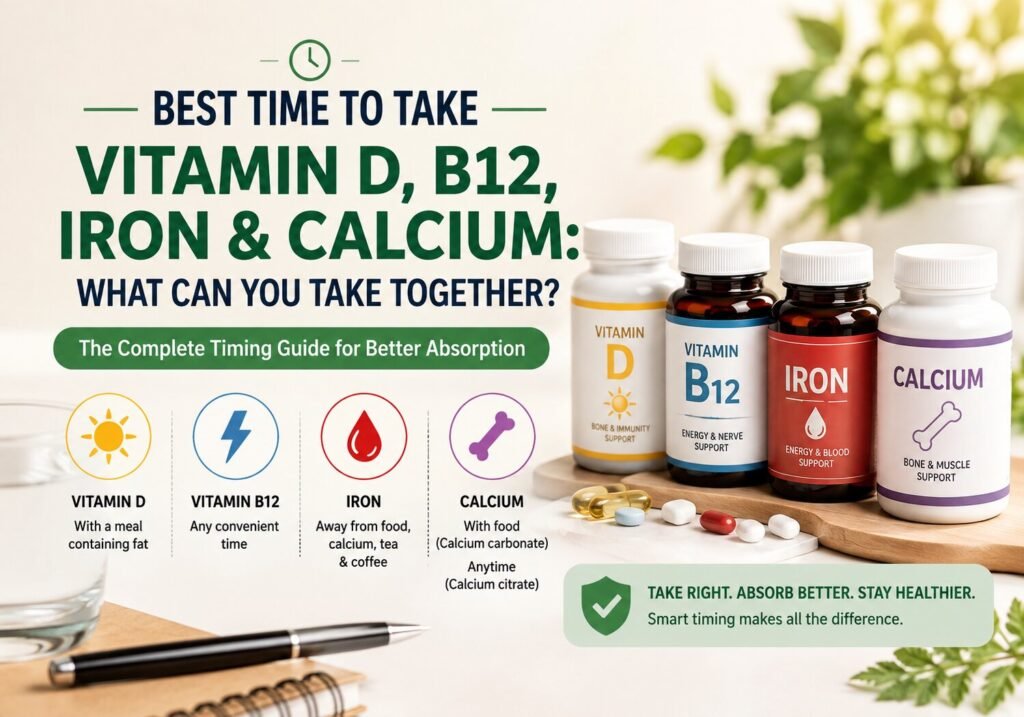
Quick answer: Vitamin D is best taken with a meal or snack containing some fat. Vitamin B12 doesn’t have a strict universal timing requirement. Iron is generally absorbed better away from food and calcium, while calcium carbonate is best taken with food. Calcium citrate can generally be taken with or without food.
The combination to remember: Keep iron and calcium supplements separate because calcium can interfere with iron absorption.
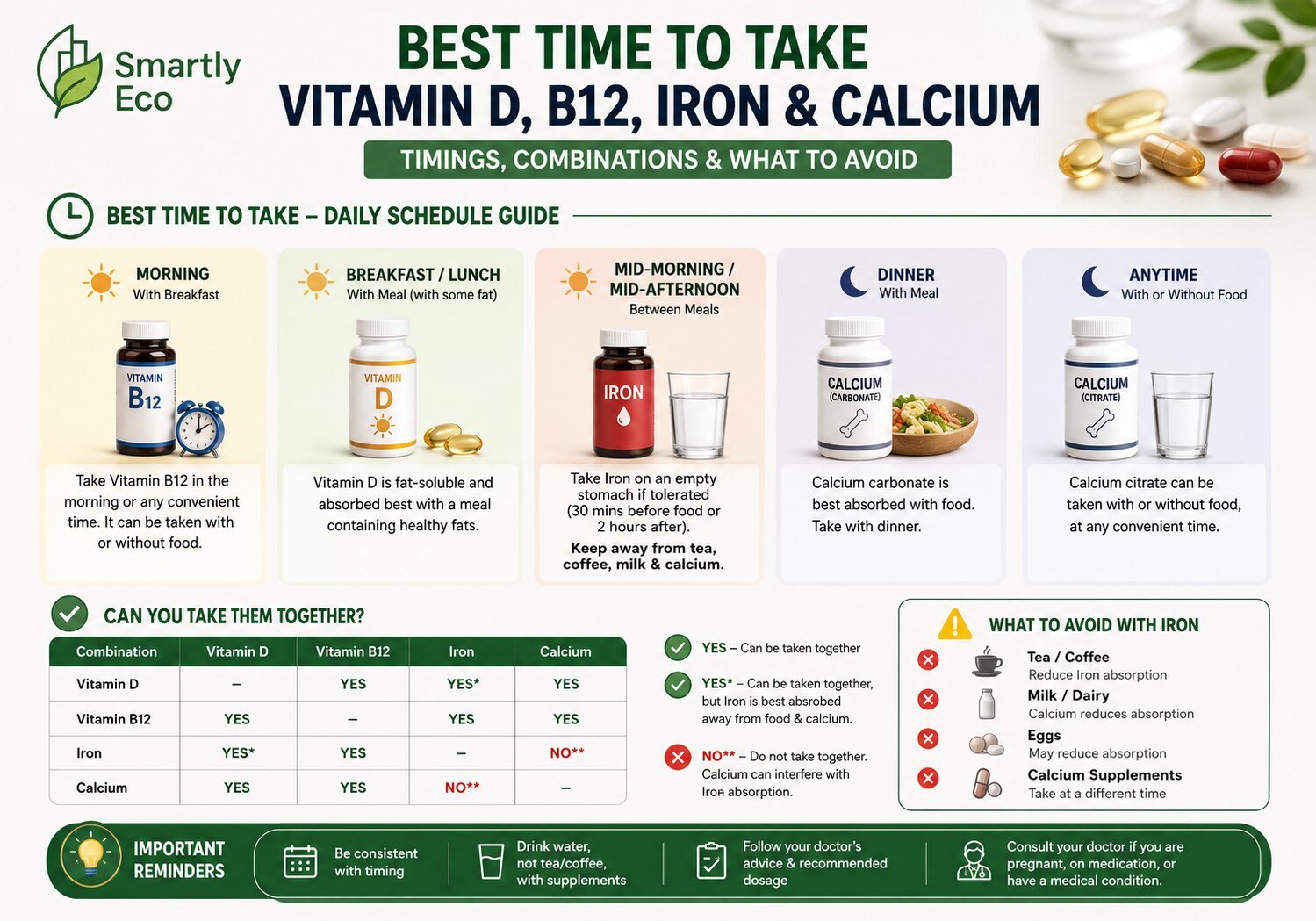
The Simple Supplement Schedule
If your doctor or healthcare professional has advised you to take all four, a practical schedule could look something like this:
| Supplement | Practical timing | With food? | Key point |
|---|---|---|---|
| Vitamin D | Breakfast or lunch | Yes, preferably with some fat | Helps calcium absorption |
| Vitamin B12 | Morning or any convenient time | With or without food | Consistency matters more than clock time |
| Iron | Between meals if tolerated | Preferably on an empty stomach | Keep away from calcium, tea and coffee |
| Calcium carbonate | With a meal | Yes | Take separately from iron |
| Calcium citrate | Any convenient time | With or without food | Take separately from iron |
This isn’t a prescription or a universal schedule. Your dose, medical condition, medications and the specific supplement you’re taking can change the advice.
1. What Is the Best Time to Take Vitamin D?
Take vitamin D with a meal or snack containing some fat.
Vitamin D is a fat-soluble vitamin, and according to the NIH Office of Dietary Supplements’ Vitamin D Fact Sheet, it is best absorbed when taken with a meal or snack that contains some fat.
So instead of taking your vitamin D tablet with only water first thing in the morning, you could take it with a normal meal such as:
- Breakfast containing eggs or dairy
- Lunch containing vegetables cooked with oil
- A meal containing nuts or seeds
- Another balanced meal containing some dietary fat
Morning or night—which is better?
There isn’t a universal rule that vitamin D must be taken in the morning. What matters more is taking it consistently with an appropriate meal.
If lunch is the meal you rarely miss, taking vitamin D with lunch may be more practical than forcing yourself to take it at breakfast.
Can vitamin D and calcium be taken together?
Yes, generally.
If you’re looking for dietary sources, explore our guide to calcium-rich foods that aren’t milk. The NIH explains the relationship between vitamin D and calcium here. That is one reason you’ll often see vitamin D and calcium combined in supplements.
However, this doesn’t mean everyone needs a calcium supplement. Your calcium needs depend on your diet, age and individual health circumstances.
2. What Is the Best Time to Take Vitamin B12?
B12 doesn’t have a strict universal “best time.”
Vitamin B12 is water-soluble, and there is no general rule saying that everyone needs to take a B12 supplement in the morning or on an empty stomach.
For most people taking an oral B12 supplement, the most convenient consistent time is usually the best time. If you’re concerned about whether you may be getting enough, our guide to vitamin deficiency symptoms is a useful starting point.
According to the NIH Office of Dietary Supplements’ Vitamin B12 Fact Sheet, B12 in food is bound to protein and must be released during digestion before it can be absorbed. B12 in supplements is already in a free form and doesn’t require that particular release step.
Can B12 be taken with vitamin D?
Generally, yes. There is no standard requirement to separate ordinary vitamin B12 and vitamin D supplements. If taking them together makes your routine easier, that’s generally reasonable.
What about taking B12 at night?
You may have heard that B12 should always be taken in the morning because it can interfere with sleep.
There isn’t a universal evidence-based rule that everyone needs to follow. If you personally notice that taking B12 late in the day doesn’t suit you, simply moving it earlier can make sense.
3. What Is the Best Time to Take Iron?
This is where timing becomes much more important.
Iron is generally absorbed better on an empty stomach.
For commonly used oral iron supplements such as ferrous sulfate, the NHS guidance on taking ferrous sulfate recommends taking it before food when possible because food can reduce absorption.
That could mean taking iron:
Mid-morning → iron → water
or
Mid-afternoon → iron → water
rather than immediately alongside a large meal. But there’s an important catch.
Better absorption isn’t useful if you can’t tolerate the supplement.
Iron supplements can cause:
- Nausea
- Constipation
- Stomach discomfort
- Diarrhoea
If taking iron on an empty stomach makes you feel unwell, the NHS notes that taking it with or after food may be an option.
In other words:
Absorption matters—but tolerability matters too.
If you’re taking iron to correct a diagnosed deficiency, follow the instructions given by your doctor or pharmacist.
What Should You Avoid Around an Iron Supplement?
This is one of the most useful things to remember.
Certain foods and drinks can interfere with iron absorption, including:
- Tea and coffee
- Milk and dairy products
- Eggs
- Calcium supplements
The NHS guidance for ferrous sulfate specifically recommends leaving a gap between iron and tea, coffee, dairy and eggs. For many Indian households, this is especially relevant.
If your usual morning routine is:
Iron tablet + chai
you may want to rethink the timing.
What Can Help Iron Absorption?
Vitamin C can increase the absorption of non-heme iron, the form of iron found primarily in plant foods.
The NIH Office of Dietary Supplements’ Iron Fact Sheet explains the role vitamin C plays in improving non-heme iron absorption.
That’s why you may see combinations such as:
- Dal + lemon
- Chana + tomato
- Beans + vegetables rich in vitamin C
The idea isn’t that lemon magically “cures” iron deficiency. Rather, vitamin C can help your body absorb the iron present in plant-based foods.
4. What Is the Best Time to Take Calcium?
The answer depends on which type of calcium supplement you’re taking.
Two common forms are:
Calcium carbonate
Calcium carbonate is absorbed best with food.
So if your supplement contains calcium carbonate, taking it alongside a meal is generally the practical approach.
Calcium citrate
Calcium citrate can generally be taken with or without food.
The NIH Office of Dietary Supplements’ Calcium Fact Sheet explains the difference between these common forms and how food affects their absorption.
So before deciding when to take calcium, check the form written on the supplement label.
Should You Take All Your Calcium at Once?
Not necessarily. The NIH calcium guidance notes that calcium absorption is highest when supplements are taken in doses of 500 mg or less at one time.
So if someone has been advised to take a large amount of supplemental calcium per day, splitting the dose may be more practical than taking it all at once.
But remember: Before reaching for a supplement, it’s also worth knowing how much calcium you can get from everyday Indian foods. See our guide to the best vegetarian calcium-rich foods. More calcium isn’t automatically better.
The Most Important Combination: Iron + Calcium
If you remember only one thing from this entire article, remember this:
Don’t routinely take iron and calcium supplements at the same time.
Calcium can interfere with iron absorption.
The NIH Office of Dietary Supplements’ Iron Fact Sheet specifically discusses calcium’s effect on iron absorption and recommends taking separate calcium and iron supplements at different times.
So instead of:
Iron + calcium → together
think:
Iron → separate time → calcium
The exact interval can depend on the supplement and your individual treatment plan, so if your doctor or pharmacist has given you a specific schedule, follow that.
Can You Take Vitamin D, B12, Iron and Calcium Together?
Let’s make this really simple.
Vitamin D + Calcium
Generally yes.
Vitamin D helps your body absorb calcium and is closely involved in calcium metabolism. Learn more from the NIH’s Vitamin D Fact Sheet.
Vitamin D + B12
Generally yes.
There is no standard requirement to separate them.
Vitamin D + Iron
Generally yes, but pay attention to the iron timing.
Vitamin D isn’t the main concern here. The important issue is that iron absorption can be affected by food, calcium, tea and coffee.
Vitamin B12 + Iron
Generally yes.
There isn’t a standard timing rule requiring these two to be separated.
Vitamin B12 + Calcium
Generally yes.
There isn’t a standard requirement to separate ordinary B12 and calcium supplements.
Iron + Calcium
Better separately.
Calcium can interfere with iron absorption, so taking them at different times is the safer approach for maximizing iron absorption.
A Practical Daily Schedule
If you’ve been advised to take all four, here’s one possible way to organize them:
🌅 Morning — Breakfast
Vitamin B12
Take it at a time that’s easy for you to remember.
🍳 Breakfast or Lunch
Vitamin D
Take it with a meal containing some fat. The NIH Vitamin D Fact Sheet explains why.
☀️ Mid-morning or Mid-afternoon
Iron
Ideally away from food if you tolerate it, and away from tea, coffee, dairy and calcium. The NHS ferrous sulfate guidance provides practical instructions.
🌙 Dinner
Calcium
If it’s calcium carbonate, take it with the meal. Calcium citrate can generally be taken with or without food. See the NIH Calcium Fact Sheet for details.
Again, this is an example schedule—not a prescription.
What If You Take Thyroid Medicine?
This is an important exception that many supplement schedules overlook.
If you take levothyroxine, calcium and iron can interfere with its absorption.
MedlinePlus’ levothyroxine guidance advises taking calcium carbonate or ferrous sulfate at least 4 hours before or 4 hours after levothyroxine.
So if you take thyroid medication, don’t simply copy the schedule above.
Your medication schedule should come first.
What About Tea and Coffee?
For many Indian households, this deserves its own reminder.
If you’re taking iron, don’t automatically pair it with your morning chai or coffee.
Tea and coffee can reduce iron absorption, and the NHS recommends leaving a gap between ferrous sulfate and tea or coffee.
A better routine could be:
Iron → water → wait → chai/coffee later
rather than:
Iron + chai
It may seem like a small change, but when you’re taking iron specifically to address a deficiency, optimizing absorption can matter.
Don’t Take Supplements Just Because You Feel Tired
Fatigue is one of the most common reasons people start taking several vitamins at once.
But feeling tired doesn’t automatically mean you have a vitamin D, B12, iron or calcium deficiency. If you’re wondering what deficiency symptoms can actually look like, here’s our guide to 12 Vitamin Deficiency Symptoms You Should Never Ignore.
For example, vitamin B12 deficiency can cause fatigue and neurological symptoms, while iron deficiency can cause tiredness and weakness—but these symptoms can have many different causes.
The NIH Vitamin B12 Fact Sheet and NIH Iron Fact Sheet explain the symptoms and health effects associated with inadequate intake and deficiency.
If you suspect a deficiency, it’s better to discuss your symptoms and appropriate testing with a healthcare professional rather than starting several high-dose supplements on your own.
This is especially important with iron.
Iron is an essential nutrient, but taking more isn’t automatically better. High supplemental amounts can cause gastrointestinal side effects and may be inappropriate for people who don’t need additional iron. The NIH’s iron guidance provides more information.
The Smart Way to Remember Your Supplements
You don’t need a complicated spreadsheet.
Think of them like this:
☀️ Vitamin D
With a meal containing some fat
⚡ Vitamin B12
Any convenient, consistent time
🩸 Iron
Preferably away from food, calcium, tea and coffee
🦴 Calcium
With food if it’s calcium carbonate; with or without food if it’s calcium citrate
And the golden rule:
Keep iron and calcium separate.
Frequently Asked Questions
Can I take vitamin D and calcium together?
Yes. They are commonly taken together, and vitamin D helps the body absorb calcium. You can read more in the NIH Vitamin D Fact Sheet.
Can I take vitamin B12 and vitamin D together?
Generally yes. There is no standard requirement to separate them.
Can I take iron and vitamin B12 together?
Generally yes. There is no standard requirement to separate these two supplements.
Can I take iron and calcium together?
It’s better to take them at different times because calcium can interfere with iron absorption. See the NIH Iron Fact Sheet for more information.
Should I take vitamin D in the morning or at night?
There isn’t a universal requirement to take it at a particular time of day. Taking vitamin D consistently with a meal or snack containing some fat is more important. (NIH)
Should B12 be taken on an empty stomach?
There isn’t a universal requirement for oral B12 supplements to be taken on an empty stomach. Follow the instructions for your specific product.
Can I take iron after eating?
Yes. If taking iron on an empty stomach causes stomach upset, taking it with or after food may be easier to tolerate. However, food can reduce iron absorption. The NHS ferrous sulfate guidance explains the trade-off.
How much calcium should I take?
That depends on your age, diet, health status and reason for supplementation. Your total calcium intake includes food as well as supplements. Don’t automatically add a high-dose calcium supplement without knowing whether you need it.
The Bottom Line
There isn’t one magical “best time” that applies to every vitamin and mineral. Instead, good supplement timing is about understanding what helps absorption—and what gets in the way.
If you’re taking these four supplements, the simplest approach is:
Vitamin D → with a meal containing some fat
Vitamin B12 → any convenient, consistent time
Iron → preferably away from food, calcium, tea and coffee
Calcium carbonate → with food
Calcium citrate → with or without food
Iron + calcium → take at different times
And remember:
A good supplement schedule cannot compensate for taking a supplement you don’t actually need.
If a blood test has shown a deficiency or a doctor has prescribed a particular dose, follow that treatment plan rather than changing the dose or timing on your own.
This article is for general education and is not a substitute for medical advice. Supplement needs and timing can vary with pregnancy, kidney or digestive conditions, medications, surgery and diagnosed deficiencies. Speak with your doctor or pharmacist before starting, stopping or changing supplements—especially iron or high-dose calcium/vitamin D.
Trusted Sources
- NIH Office of Dietary Supplements — Vitamin D
- NIH Office of Dietary Supplements — Vitamin B12
- NIH Office of Dietary Supplements — Iron
- NIH Office of Dietary Supplements — Calcium
- NHS — How and when to take ferrous sulfate
- MedlinePlus — Levothyroxine

Nikita Palesha is a wellness writer and co-founder of Smartly Eco, focused on nutrition, natural health, and sustainable urban living. She researches and simplifies evidence-based health practices for everyday Indians — from managing vitamin deficiencies and thyroid health to building chemical-free skincare routines. Her writing draws on Ayurvedic principles, modern nutrition science, and a belief that the most effective health choices are also the most affordable.