Every Indian kitchen has an oil debate.
Mustard oil or groundnut?
Sunflower or olive?
Is coconut oil actually healthier?
Is cold-pressed automatically better?
Can olive oil be used for tadka?
Does “refined” mean unhealthy?
The internet doesn’t make these questions easier. One article tells you to switch to mustard oil. Another calls olive oil the healthiest. Someone else says sunflower oil is full of “bad omega-6.” Then comes the claim that coconut oil is a superfood. The truth is considerably less dramatic.
We’ve already looked at some of the biggest myths surrounding cooking oils in our cooking oil truth guide. Here, we’re taking the next step: comparing the oils themselves.
There is no single cooking oil that is the healthiest choice for every Indian household, every dish and every person.
The better question is:
What type of fat does the oil contain, how are you using it, how much are you using, and what does the rest of your diet look like?
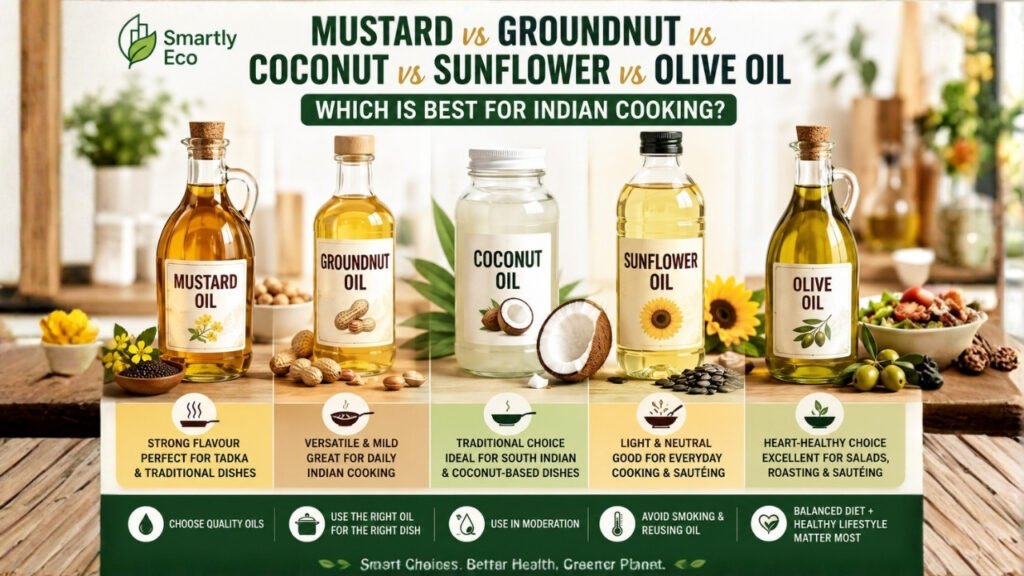
So let’s compare five oils commonly considered for Indian cooking—mustard, groundnut, coconut, sunflower and olive oil—without turning any of them into a miracle food or a villain.
The Quick Answer: Which Oil Should You Choose?
If you want the short version:
| Oil | Best suited for | Main fat profile | What stands out | Our take |
|---|---|---|---|---|
| Mustard | Tadka, sabzi, fish, regional cooking | Mostly unsaturated, with ALA; also contains erucic acid | Strong flavour; traditional Indian use | Good option, but not a “miracle oil” |
| Groundnut | Everyday Indian cooking, sautéing, frying | Rich in monounsaturated fat | Mild flavour and versatile | Strong everyday option |
| Coconut | South Indian/coastal dishes | Very high in saturated fat | Distinct flavour and good heat stability | Useful for flavour, but don’t treat it as a heart-health superfood |
| Sunflower | Everyday cooking, sautéing | Often high in polyunsaturated fat; composition varies by variety | Neutral flavour and widely available | Reasonable option; check the type and overall diet |
| Olive | Salads, sautéing, roasting and many cooked dishes | High in monounsaturated fat | Particularly strong evidence around extra-virgin olive oil | Excellent option if it fits your budget and cuisine |
The American Heart Association recommends replacing saturated fats with unsaturated fats and lists olive, peanut and sunflower oils among healthier liquid cooking-oil choices. It also recommends limiting tropical oils such as coconut oil because they contain considerably more saturated fat. (www.heart.org)
But that doesn’t mean you need to throw your mustard oil or coconut oil in the bin. Context matters.
First, Let’s Fix One Big Cooking-Oil Myth
“The healthiest oil” is not a single product.
An oil isn’t healthy simply because it is:
- Cold-pressed
- Traditional
- Expensive
- Imported
- Organic
- Unrefined
- “Natural”
- Rich in one particular fatty acid
And an oil isn’t automatically unhealthy simply because it is refined. What matters is the fatty-acid composition, processing, cooking practices, quantity consumed and your overall dietary pattern.
The American Heart Association’s current dietary guidance emphasizes replacing saturated fats with unsaturated fats rather than focusing on one “perfect” oil. (www.heart.org)
That’s a much more useful way to think about cooking oil.
1. Mustard Oil: The Indian Traditional Favourite
Mustard oil is deeply rooted in Indian cooking, particularly in eastern and northern regions. Its strong aroma and sharp flavour make it particularly distinctive in:
- Fish curry
- Aloo bharta
- Sarson-based dishes
- Pickles
- Sabzis
- Tadka
- Bengali and Bihari cooking
Nutritionally, mustard oil is relatively low in saturated fat and contains unsaturated fats, including alpha-linolenic acid (ALA), an omega-3 fatty acid.
But there is an important detail that often gets ignored.
Mustard oil contains erucic acid.
Erucic acid is a monounsaturated fatty acid that has been the subject of considerable safety discussion.
A review published in the Journal of the American College of Cardiology notes that mustard oil contains a relatively large proportion of erucic acid and that regulatory positions differ between countries. (PubMed)
That means we shouldn’t make either of these claims:
❌ “Mustard oil is dangerous.”
or
❌ “Mustard oil is the healthiest oil.”
The evidence and regulatory context are more complicated than either statement suggests.
So, should Indians stop using mustard oil?
Not necessarily. If mustard oil is part of your traditional diet and you enjoy it, it can be one of several oils in a varied diet.
But there is no need to treat it as a medicinal oil.
2. Groundnut Oil: The Underrated Everyday Option
Groundnut oil—also called peanut oil—is particularly familiar in western and central Indian kitchens.
It works well for:
- Sautéing
- Sabzis
- Thepla
- Bhaji
- Stir-frying
- Some frying applications
One of its biggest advantages is its fat profile.
Peanut oil is relatively rich in monounsaturated fat and contains less saturated fat than coconut oil.
The American Heart Association lists peanut oil among the liquid plant oils that can be healthier choices when replacing saturated fats. (www.heart.org)
What about its flavour?
Compared with mustard oil, groundnut oil is relatively mild. That makes it useful when you don’t want the cooking oil to dominate the flavour of the dish.
A good everyday choice?
Yes.
For someone looking for a versatile Indian cooking oil, groundnut oil can be a perfectly reasonable option. You don’t need an imported oil simply because it sounds more “premium.”
3. Coconut Oil: Traditional Doesn’t Automatically Mean Heart-Healthy
Coconut oil has developed something of a cult following. You’ll hear claims about:
metabolism
weight loss
brain health
immunity
“good cholesterol”
natural energy
But let’s separate tradition from evidence. Coconut oil is very high in saturated fat. Compared with many liquid plant oils, its fatty-acid profile is substantially more saturated. (WhatYouEat)
And that matters because replacing saturated fats with unsaturated fats is generally associated with a more favourable cardiovascular risk profile. A systematic review and meta-analysis of clinical trials found that coconut oil raised LDL cholesterol compared with non-tropical vegetable oils. (PubMed)
Another randomized trial found a more favourable lipid profile with corn oil than coconut oil in adults with elevated cholesterol. (PubMed)
Does that mean coconut oil is “bad”?
No. It means coconut oil shouldn’t be marketed as a heart-health superfood simply because it is natural or traditional. It can still be an excellent culinary choice when you actually want its flavour.
Think:
Avial + coconut oil
South Indian vegetable preparations + coconut
Coconut-based curries
rather than:
“I’m using coconut oil because it must be healthier than every other oil.”
Smartly Eco verdict:
Excellent culinary oil. Not a nutritional miracle.
4. Sunflower Oil: Is It Really the Villain?
Sunflower oil gets a lot of criticism online. The common argument goes:
“Sunflower oil contains omega-6, therefore it causes inflammation.”
That’s an oversimplification. Standard sunflower oil is often relatively high in linoleic acid, an omega-6 polyunsaturated fatty acid. But omega-6 fatty acids are essential fats; your body needs them. The American Heart Association recommends replacing saturated fats with unsaturated fats, including polyunsaturated fats. (www.heart.org)
There is also more than one type of sunflower oil.
Its fatty-acid composition can vary considerably depending on the variety. For example, high-oleic sunflower oil is much richer in monounsaturated fat than conventional high-linoleic sunflower oil. (WhatYouEat)
So simply saying:
“Sunflower oil is unhealthy”
doesn’t tell the whole story.
Why do people like it?
It has:
- Mild flavour
- Wide availability
- Familiarity
- Good versatility
The bigger issue
If your diet is dominated by highly processed foods, deep-fried snacks and excess calories, changing from one bottle of vegetable oil to another won’t suddenly make the diet healthy.
The overall dietary pattern matters far more.
5. Olive Oil: Does It Actually Work in an Indian Kitchen?
Now we come to the oil that often gets placed on a pedestal. Olive oil has strong evidence behind its role in healthy dietary patterns, particularly extra-virgin olive oil.
It is rich in monounsaturated fat and contains naturally occurring compounds, particularly in extra-virgin olive oil. But there’s a common misconception:
“Olive oil is only for salads.”
Not true.
The International Olive Council states that olive oil can be used for cooking and frying, and notes that its smoke point is around 210°C. (International Olive Council) So you can absolutely use olive oil for many cooked dishes. You don’t need to avoid cooking it simply because someone told you:
“Never heat olive oil.”
But should you use it for every Indian dish?
That’s a different question.
Extra-virgin olive oil has a distinctive flavour that may work beautifully in:
- Roasted vegetables
- Salads
- Pasta
- Light sautéing
- Mediterranean-style dishes
But if you’re making a traditional Bengali fish curry, Gujarati shaak or a Punjabi tadka, the flavour of mustard or groundnut oil may simply make more culinary sense.
Healthy eating doesn’t require abandoning your food culture.
So Which Oil Has the Best Fat Profile?
Here’s where the comparison gets interesting.
The broad nutritional principle is:
More unsaturated fat generally works in your favour when it replaces saturated fat.
The American Heart Association recommends choosing oils richer in monounsaturated and polyunsaturated fats instead of sources high in saturated and trans fats. (www.heart.org)
That gives oils such as:
Olive → strong monounsaturated profile
Groundnut → rich in monounsaturated fat
Sunflower → generally rich in polyunsaturated fat, depending on variety
Mustard → predominantly unsaturated, but with the additional consideration of erucic acid
Coconut → predominantly saturated fat
So if cardiovascular health is your primary consideration, coconut oil shouldn’t automatically outrank unsaturated plant oils.
But What About Smoke Point?
This is another area where the internet oversimplifies things. You’ll often see articles ranking oils solely by smoke point:
“Oil A has a higher smoke point, so it’s healthy.”
That’s not enough. When an oil reaches its smoke point, it begins to break down, and the cooking conditions matter. The American Heart Association recommends avoiding oil that starts smoking and advises against reusing or reheating cooking oil. (www.heart.org)
So instead of obsessing over a single smoke-point number, focus on:
- Don’t let the oil visibly smoke.
- Don’t repeatedly reuse cooking oil.
- Match the oil to the cooking method.
- Don’t use excessive amounts simply because an oil is considered “healthy.”
What About Deep Frying?
Here’s something that often gets lost in the oil debate:
Deep-frying isn’t made healthy simply by changing the oil.
Even if you use an oil with a favourable fatty-acid profile, deep-fried food is still deep-fried food. The American Heart Association specifically does not recommend deep-fat frying as a healthy cooking method. (www.heart.org) And repeatedly heating and reusing oil isn’t a smart kitchen habit.
If you’ve got a pan of oil left after frying pakoras, don’t assume that filtering it and reheating it several times makes it equivalent to fresh oil.
Fresh oil + sensible cooking beats repeatedly reheated oil.
Refined vs Cold-Pressed: Which One Should You Buy?
This is probably the biggest practical question at the supermarket. You’ll see:
- Cold-pressed
- Wood-pressed
- Kachi ghani
- Refined
- Extra virgin
- Organic
But these terms don’t automatically tell you whether an oil is the right choice for your health.
Cold-pressed oils
These are produced through mechanical extraction rather than certain refining steps. They can retain more of the oil’s natural flavour and minor compounds.
But:
Cold-pressed does not mean unlimited quantities are healthy.
Oil is still calorie-dense.
Refined oils
Refining can remove colour, odour and certain minor components and can improve stability and consistency. That does not mean every refined oil is a toxic chemical or automatically creates trans fats.
That distinction matters. In fact, FSSAI’s labelling regulations specifically recognize refined vegetable oils as a regulated category and prescribe how they should be labelled. (FSSAI)
So don’t let marketing turn:
“cold-pressed”
into:
“healthy in unlimited quantities.”
The same principle applies to packaged foods: don’t judge a product only by what appears on the front of the package. Our guide to fake healthy foods and misleading health claims explains how marketing can make ordinary products appear healthier than they really are.
What About “Multi-Source” Cooking Oils?
You may also see blended or multi-source edible oils in Indian supermarkets. This isn’t automatically a red flag. FSSAI regulations require packaged multi-source edible oils to identify them as “MULTI-SOURCE EDIBLE OIL” and disclose the oils and their proportions on the label. (FSSAI)
So when buying a blend:
Read the label.
Don’t judge the oil solely by the front of the bottle.
Which Oil Is Best for Which Indian Dish?
Here’s where the answer becomes much more practical.
| Food / cooking method | Good choices |
|---|---|
| Gujarati sabzi | Groundnut, sunflower, mustard depending on flavour |
| Bengali fish curry | Mustard |
| Punjabi-style cooking | Mustard, groundnut or another suitable liquid plant oil |
| South Indian dishes | Coconut, sesame or another suitable plant oil |
| Tadka | Mustard, groundnut, sunflower, olive or other suitable oil depending on flavour |
| Salads | Extra-virgin olive oil |
| Roasting vegetables | Olive, groundnut or sunflower |
| General sautéing | Groundnut, olive or sunflower |
| Occasional frying | Suitable fresh oil; avoid repeated reuse |
The important word is “suitable.” There isn’t one oil that needs to dominate every dish.
Should You Rotate Cooking Oils?
You may have heard:
“You must rotate your oils every month.”
There isn’t a universal scientific rule saying everyone must change oils according to a fixed schedule. But using different oils for different culinary purposes can be a sensible way to diversify the fats in your diet.
For example:
- Groundnut for everyday cooking
- Mustard for dishes where its flavour works
- Coconut for coconut-based cuisine
- Olive oil for salads or suitable cooked dishes
The goal isn’t to create a complicated oil rotation chart. It’s to avoid thinking that one particular oil is a nutritional cure-all.
The Bigger Question: How Much Oil Are You Using?
This is the part most “best cooking oil” articles forget. You could choose an excellent unsaturated oil and still consume more calories than you need if you pour it generously into every meal.
All cooking oils are energy-dense. So instead of asking only:
“Which oil is healthiest?”
ask:
“How much added oil am I actually using every day?”
That question may have a much bigger effect on your overall diet than switching between two reasonably good oils.
7 Mistakes Indians Make With Cooking Oil
1. Thinking expensive = healthier
Price isn’t a nutritional score.
2. Choosing oil based only on the front label
Read the nutrition and ingredient information.
3. Reusing frying oil repeatedly
Fresh oil is preferable. The American Heart Association advises against reusing or reheating cooking oil. (www.heart.org)
4. Believing “cold-pressed” means unlimited
It doesn’t.
5. Treating coconut oil as a heart-health supplement
Coconut oil is high in saturated fat, and clinical evidence does not support treating it as superior to unsaturated plant oils for cardiovascular health. (PubMed)
6. Thinking sunflower oil automatically causes inflammation
That’s an oversimplification of how dietary fats work. Polyunsaturated fats are essential, and their health effects need to be considered in the context of the overall diet. (www.heart.org)
7. Letting oil smoke
If your cooking oil is visibly smoking, reduce the heat and don’t continue cooking in it. (www.heart.org)
So, Which Is the Best Cooking Oil in India?
If you want us to pick one winner, we’d actually be misleading you.
For an everyday Indian kitchen:
Groundnut oil is a strong all-purpose option for many households.
For traditional regional flavour:
Mustard oil can be excellent where its distinctive flavour fits.
For South Indian and coconut-based dishes:
Coconut oil can make culinary sense—but don’t confuse traditional use with proof that it is the healthiest fat.
For a neutral everyday oil:
Sunflower oil can be reasonable, particularly when used sensibly as part of an overall balanced diet.
For salads, roasting and many cooked dishes:
Extra-virgin olive oil is an excellent option if you enjoy the flavour and can comfortably afford it.
But there’s an even bigger answer:
The healthiest kitchen isn’t the one with the “perfect” bottle of oil. It’s the one that uses reasonable amounts of mostly unsaturated fats, avoids repeatedly heated oil, and serves those fats alongside a diet rich in vegetables, pulses, whole grains, nuts, seeds and other minimally processed foods.
That’s a much less exciting answer than “this one oil will change your health.” But it’s much closer to the evidence.
Smartly Eco’s Simple Oil Rule
Don’t choose your cooking oil based on:
❌ Celebrity recommendations
❌ “Detox” claims
❌ “Superfood” labels
❌ Price
❌ Imported = healthy
❌ Traditional = automatically healthy
❌ Refined = automatically toxic
Instead, choose based on:
✅ Fat profile
✅ Cooking method
✅ Cuisine and flavour
✅ Quality and freshness
✅ Amount used
✅ Your individual health needs
✅ The overall quality of your diet
The goal isn’t to find one magical oil.
The goal is to cook smarter.
Frequently Asked Questions
Which is healthier, mustard oil or groundnut oil?
Both can fit into a balanced diet. Groundnut oil is rich in monounsaturated fat, while mustard oil contains substantial unsaturated fat but also contains erucic acid. There isn’t enough evidence to declare one universally “healthier” for every person and every use. (PubMed)
Is coconut oil healthier than sunflower oil?
Not automatically. Coconut oil is much higher in saturated fat, while conventional sunflower oil is generally richer in polyunsaturated fat. Current cardiovascular guidance generally favours replacing saturated fat with unsaturated fats. (www.heart.org)
Can olive oil be used for Indian cooking?
Yes. Olive oil can be used for many cooking methods, including sautéing and roasting. It doesn’t have to be restricted to salads. (International Olive Council)
Is cold-pressed oil always healthier?
No. Cold-pressed describes how an oil is extracted; it doesn’t mean you can consume unlimited quantities or that the oil is automatically superior for every cooking purpose.
Is sunflower oil unhealthy?
Not inherently. Sunflower oil’s composition varies by variety, and it contains unsaturated fats. The overall dietary pattern and amount consumed matter. (www.heart.org)
Which oil is best for frying?
No oil makes deep-frying a health food. If you fry, avoid letting the oil smoke and don’t repeatedly reuse or reheat cooking oil. (www.heart.org)
Should I completely stop using refined oil?
Not necessarily. “Refined” describes processing and does not by itself mean that an oil is toxic or contains trans fats. Look at the specific oil, its fatty-acid profile, the label and how you use it.
Can I use more than one cooking oil?
Yes. There is no requirement to stick to one oil for every dish. Using different oils according to cuisine and cooking method can be perfectly reasonable.
Final Verdict
The Indian cooking-oil debate doesn’t need another villain.
Mustard oil isn’t a miracle.
Coconut oil isn’t a superfood.
Sunflower oil isn’t automatically inflammatory.
Olive oil isn’t only for salads.
Cold-pressed doesn’t mean unlimited.
Refined doesn’t automatically mean toxic.
Instead, understand what you’re buying.
Choose oils that fit your cooking, favour unsaturated fats where appropriate, use reasonable amounts, don’t let oil smoke, and avoid repeatedly reheating it.
Because when it comes to cooking oil:
The smartest choice isn’t the bottle with the loudest health claim. It’s the one that fits your food, your diet and the evidence.
Sources & Further Reading
- American Heart Association — Healthy Cooking Oils
- American Heart Association — Fats in Foods
- American Heart Association — Saturated Fats
- International Olive Council — Olive Oil
- NIH/PubMed — Mustard Oil and Cardiovascular Health
- NIH/PubMed — Coconut Oil and Cardiometabolic Risk
- FSSAI — Food Labelling Regulations
This article is for general educational purposes and does not replace individual medical or dietary advice. People with conditions such as high cholesterol, cardiovascular disease, diabetes or other medical concerns should discuss dietary-fat choices with a qualified healthcare professional or registered dietitian.

Nikita Palesha is a wellness writer and co-founder of Smartly Eco, focused on nutrition, natural health, and sustainable urban living. She researches and simplifies evidence-based health practices for everyday Indians — from managing vitamin deficiencies and thyroid health to building chemical-free skincare routines. Her writing draws on Ayurvedic principles, modern nutrition science, and a belief that the most effective health choices are also the most affordable.