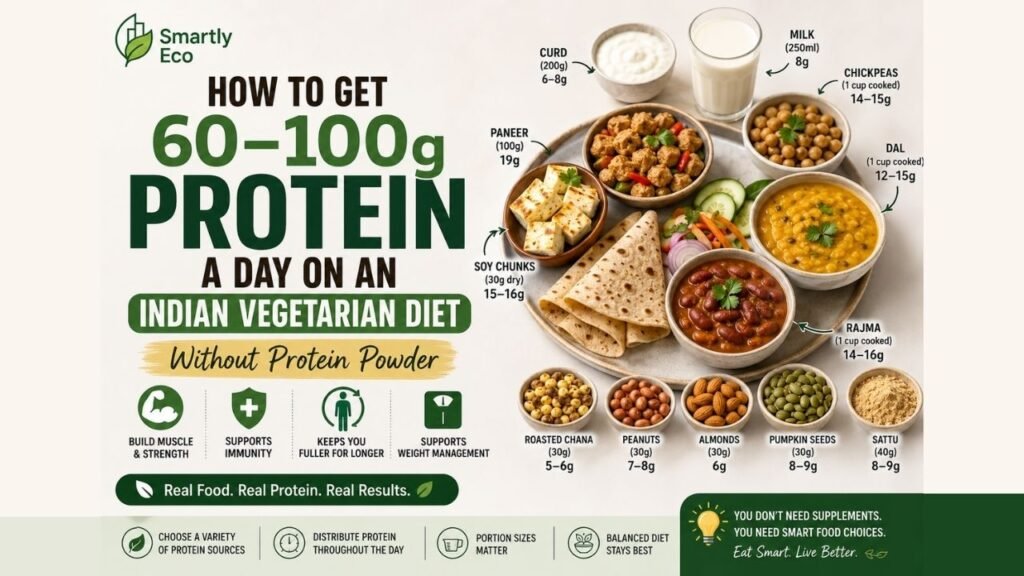
If you are vegetarian in India, getting enough protein does not mean you need protein powder, expensive imported foods or complicated meal plans.
Dal, paneer, curd, milk, soy, chickpeas, rajma, sattu, roasted chana, nuts and seeds can collectively provide plenty of protein.
The important part is portion size and consistency.
According to the ICMR-NIN Dietary Guidelines for Indians 2024, the recommended dietary allowance for protein for healthy adults is around 0.83 g per kg body weight per day. For a 65 kg adult, that works out to roughly 54 g per day. Protein needs can be higher depending on factors such as training, muscle-building goals and individual circumstances.
So, 60–100g is not a universal requirement. Think of it as a practical range that may suit some active adults—not a number everyone needs to chase.
Quick Answer: Can Vegetarians Get 100g Protein Without Whey?
Yes. A vegetarian Indian diet can reach 60–100g protein by combining foods such as:
- Dal and other pulses
- Paneer
- Tofu
- Soy chunks
- Milk and curd
- Chickpeas and rajma
- Sattu
- Roasted chana
- Peanuts and nuts
- Seeds
ICMR-NIN’s Indian Food Composition Tables (IFCT) provide nutrient-composition data for Indian foods, although the actual protein content can vary by variety, brand, preparation and water content.
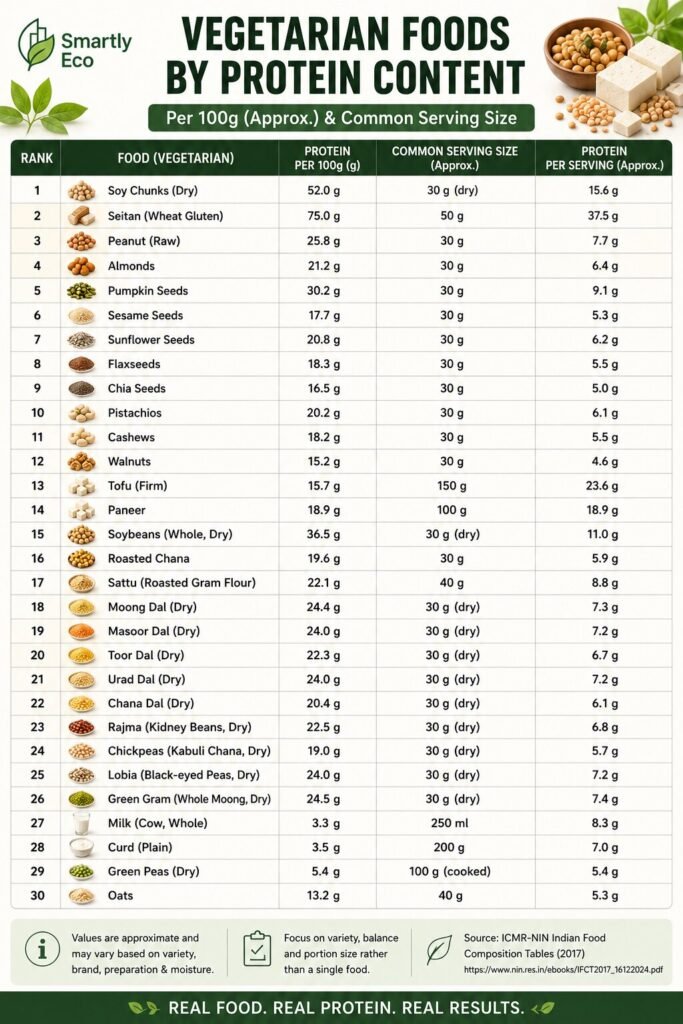
How Much Protein Is in Common Indian Vegetarian Foods?
Here is the practical part. The numbers below are approximate. For cooked foods, water absorption can substantially change protein concentration per 100g, while packaged foods can vary by brand.
| Food | Approx. protein | Practical serving | Approx. protein in serving |
|---|---|---|---|
| Soy chunks, dry | ~50–52g/100g | 30g dry | ~15–16g |
| Paneer | ~18–19g/100g | 100g | ~19g |
| Tofu | ~10–15g/100g | 150g | ~15–22g |
| Moong dal, cooked | ~7g/100g | 1 cup (~180–200g) | ~13–14g |
| Other cooked dal | ~6–9g/100g | 1 cup | ~11–18g |
| Chickpeas, cooked | ~8–9g/100g | 1 cup | ~14–15g |
| Rajma, cooked | ~8–9g/100g | 1 cup | ~14–16g |
| Milk | ~3.2–3.3g/100ml | 250ml | ~8g |
| Curd | ~3–4g/100g | 200g | ~6–8g |
| Roasted chana | ~18–20g/100g | 30g | ~5–6g |
| Sattu | ~20–22g/100g | 40g | ~8–9g |
| Peanuts | ~25–26g/100g | 30g | ~7–8g |
| Almonds | ~20–21g/100g | 30g | ~6g |
| Pumpkin seeds | ~25–30g/100g | 30g | ~8–9g |
For example, the ICMR-NIN IFCT database lists approximately 18.86g protein per 100g of paneer and 3.26g per 100g of whole cow’s milk. These are database averages, so the nutrition label on your particular product should take priority.
Important: Don’t compare dry soy chunks with cooked dal gram-for-gram. Cooking adds water, which changes the protein concentration by weight.
1. Soy Chunks: The Vegetarian Protein Shortcut
If you want to increase protein without dramatically increasing the amount of food you eat, soy chunks are one of the easiest options. Dry soy chunks can contain roughly 50g or more protein per 100g, depending on the product.
That means:
30g dry soy chunks → approximately 15–16g protein
50g dry soy chunks → approximately 25g protein
You can add them to:
- Soy keema
- Pulao
- Vegetable curry
- Biryani
- Stir-fry
- Stuffed paratha
- Chilla fillings
The important thing is to check the nutrition label because different products can have different protein concentrations.
Reference: ICMR-NIN Indian Food Composition Tables
2. Paneer: Easy Protein for Indian Meals
Paneer is convenient because it fits naturally into Indian cooking. According to the ICMR-NIN IFCT, paneer contains approximately 18.9g protein per 100g.
That gives you roughly:
- 50g paneer → ~9–10g protein
- 100g paneer → ~19g protein
- 150g paneer → ~28g protein
You can use it in:
- Paneer bhurji
- Paneer tikka
- Palak paneer
- Paneer wraps
- Paneer sandwiches
- Paneer + vegetables
One thing to remember: paneer can also be relatively calorie-dense because of its fat content. So if your goal is fat loss, protein quantity and total calories both matter.
3. Dal: Don’t Underestimate the Everyday Staple
Dal doesn’t have to be treated as a side dish. It can be one of the main protein sources in a vegetarian Indian diet. Depending on the variety and preparation, one cup of cooked dal can provide roughly 11–18g protein.
For example:
1 cup cooked dal → approximately 12–15g protein
Combine it with:
- Roti
- Rice
- Vegetables
- Curd
and you have a much more nutritionally balanced meal.
ICMR-NIN also emphasizes the importance of a diverse diet and appropriate combinations of cereals and pulses for improving protein quality. You can read the ICMR-NIN Dietary Guidelines for Indians 2024 for the broader dietary guidance.
4. Chickpeas and Rajma
Chana and rajma are another simple way to increase protein while also getting fibre. Approximate values:
1 cup cooked chickpeas → ~14–15g protein
1 cup cooked rajma → ~14–16g protein
Try them as:
- Chole
- Rajma
- Chana salad
- Chana chaat
- Rajma rice
- Chickpea wraps
The key is portion size. A small spoonful of chana won’t suddenly turn a meal into a high-protein meal.
5. Milk and Curd
Dairy can quietly contribute a useful amount of protein throughout the day. The ICMR-NIN IFCT lists whole cow’s milk at approximately 3.26g protein per 100g.
So:
250ml milk → roughly 8g protein
Curd can provide roughly 3–4g protein per 100g, depending on the product.
Therefore:
200g curd → roughly 6–8g protein
Instead of thinking of curd as only a cooling side dish, use it as part of your protein strategy:
- Curd + roasted chana
- Curd + besan chilla
- Curd + stuffed paratha
- Curd with lunch
- Hung curd dips
6. Sattu: An Underrated Indian Protein Food
Sattu is particularly useful because it is inexpensive, convenient and easy to incorporate into Indian meals. A typical sattu powder can provide roughly 20–22g protein per 100g, although the exact amount varies by the pulses used and the product.
That means:
40g sattu → approximately 8–9g protein
Try:
- Sattu drink
- Sattu paratha
- Sattu stuffed roti
- Sattu chilla
- Sattu + curd
Just remember that sattu is still a food—not a magic protein supplement.
7. Roasted Chana
Roasted chana is one of the easiest desk or travel snacks for an Indian vegetarian. Approximately:
30g roasted chana → ~5–6g protein
A larger 50g portion can provide around 9–10g protein.
It is particularly useful when you need something more substantial than biscuits or sugary snacks. If you’re trying to improve your everyday food choices, our guide on fake healthy foods and how food marketing can mislead you is worth reading alongside this article.
8. Nuts and Seeds: Useful, But Don’t Make Them Your Main Protein Source
Peanuts, almonds and seeds contain meaningful amounts of protein.
Approximate amounts:
- 30g peanuts → ~7–8g protein
- 30g almonds → ~6g protein
- 30g pumpkin seeds → ~8–9g protein
But there is an important catch:
Nuts and seeds are also calorie-dense. So eating 100g peanuts just to increase protein isn’t necessarily a smart strategy if you’re also trying to manage calorie intake. Use them as supporting protein sources, rather than your primary protein source.
What Does a 60–70g Protein Vegetarian Day Look Like?
You don’t need to completely redesign Indian food.
Breakfast
Moong dal chilla + curd
- Moong dal used for chilla → ~12–14g
- 150g curd → ~5–6g
Total: ~17–20g protein
Mid-Morning
250ml milk
- ~8g protein
Lunch
1 cup dal + 2 rotis + vegetables
- Dal → ~12–15g
- Two rotis → ~6g
- Vegetables → ~2–3g
Total: ~20–24g
Evening
30g roasted chana
- ~5–6g
Dinner
100g paneer + vegetables + 1–2 rotis
- Paneer → ~19g
- Roti + vegetables → ~5–8g
Total: ~24–27g
You could therefore easily end up around 75g+ protein, depending on the exact portions.
What Does a 90–100g Protein Vegetarian Day Look Like?
For someone who specifically has a higher protein target, you can increase the protein density of the meals.
Breakfast
Moong dal chilla + curd
→ ~18–20g
Mid-Morning
250ml milk + 30g roasted chana
→ ~13–14g
Lunch
Dal + rice + curd
- Dal → ~12–15g
- Rice → ~4–5g
- Curd → ~6–8g
Total: ~22–28g
Evening
30g dry soy chunks, prepared as a snack/curry
→ ~15–16g
Dinner
150g paneer + 1–2 rotis + vegetables
- Paneer → ~28g
- Roti + vegetables → ~5–8g
Total: ~33–36g
Depending on the exact portions, this type of day can approach or exceed 100g protein.
You don’t have to eat exactly these foods every day. The idea is to understand how protein adds up across meals.
The Biggest Mistake: Only Eating Protein at Dinner
Imagine your entire day looks like this:
Breakfast: Poha
Lunch: Roti + sabzi
Snack: Biscuits
Dinner: Paneer + dal
You may technically be eating protein, but most of it is concentrated in one meal.
A better approach is:
Breakfast → Protein
Dal chilla + curd
Lunch → Protein
Dal/rajma/chole + roti/rice
Snack → Protein
Roasted chana/sattu/curd
Dinner → Protein
Paneer/tofu/soy + vegetables
This makes reaching your daily target much easier.
Do You Need to Combine Proteins at Every Meal?
Not necessarily. You don’t need to obsessively calculate amino acids every time you eat dal or roti.
ICMR-NIN’s dietary guidance emphasizes dietary diversity and combinations such as cereals and pulses to improve overall protein quality. A varied vegetarian diet can provide the essential amino acids you need.
Think:
Roti + dal
Rice + rajma
Chilla + curd
Paneer + roti
Soy + rice
rather than trying to engineer a “perfect” protein combination at every bite. For more detail, see the ICMR-NIN Dietary Guidelines for Indians.
What About Protein Powder?
Protein powder is optional, not mandatory.
ICMR-NIN’s 2024 dietary guidance notes that most athletes can obtain recommended protein through food alone and that protein powders are not inherently required.
That doesn’t mean protein supplements are automatically bad.
They can be useful when:
- You struggle to eat enough food
- You have a very high protein requirement
- You’re travelling
- Your schedule makes meals difficult
- You need a convenient protein source
But if you’re simply trying to get 60–80g protein a day, your kitchen may already have plenty of options.
5 Common Mistakes Indian Vegetarians Make With Protein
1. Starting with supplements
Don’t immediately assume you need whey. First look at your regular food.
2. Eating all your protein at dinner
Spread protein across your meals.
3. Counting only “protein foods”
Roti, rice, milk, vegetables, nuts and other foods also contribute protein. The total comes from your entire day’s diet.
4. Eating unlimited nuts because they’re “high protein”
Nuts are nutritious, but they are calorie-dense. Use them strategically.
5. Copying an athlete’s protein intake
A professional athlete’s diet isn’t automatically appropriate for you. Your protein target depends on your body size, activity, goals, overall diet and individual circumstances.
If you’re trying to lose weight, our Indian fat-loss diet guide can also help put protein into the larger context of sustainable eating.
The Simple 4-Step Formula
If you don’t want to count every gram, use this simple approach:
Step 1: Put a protein source in every major meal
Dal, paneer, tofu, soy, curd, chana or another protein-rich food.
Step 2: Add one protein-rich snack
Roasted chana, sattu, curd, milk or a measured portion of nuts/seeds.
Step 3: Increase portions when necessary
If ½ cup dal isn’t getting you where you need to be, increase the portion or add another protein source.
Step 4: Look at the entire day
Don’t judge your protein intake from one meal.
Your body doesn’t care whether your protein came from breakfast, lunch or dinner—it is your overall daily intake that matters.
Frequently Asked Questions
Can vegetarians get 100g protein a day?
Yes. A vegetarian diet can provide 100g protein using foods such as soy, paneer, dal, curd, milk, legumes and other protein-rich foods. However, 100g is not a universal requirement.
What is the highest-protein vegetarian food?
Dry soy products are among the most protein-dense vegetarian options. Paneer, legumes, dairy and several seeds also contribute meaningful amounts.
Is dal enough for protein?
Dal is an excellent protein source, but relying on only one food is unnecessary. Combining pulses with cereals, dairy and other plant foods creates a more varied diet.
Can I build muscle without whey protein?
Yes. Muscle development depends on an adequate overall diet and appropriate resistance training; whey is a convenient protein source, not a requirement.
Is paneer good for a high-protein diet?
Paneer is protein-rich, but it can also be relatively high in fat and calories. Portion size matters, particularly if fat loss is your goal.
Is sattu a good protein source?
Yes. Sattu can contribute useful protein and fibre, although its exact nutritional composition depends on the ingredients and brand.
Final Takeaway
You don’t need a shaker bottle at every meal to eat a high-protein vegetarian diet. You need to make protein visible on your plate.
Instead of:
Roti + sabzi
try:
Roti + dal + sabzi + curd
Instead of:
Tea + biscuits
try:
Milk + roasted chana
Instead of:
Plain rice + vegetables
try:
Rice + rajma/chole + vegetables
Small changes can add up surprisingly quickly. And before you decide that you need 100g protein every day, remember: your ideal intake depends on your body, activity level and goals.
For general healthy adults, use evidence-based recommendations such as those from ICMR-NIN as your starting point—not social-media fitness targets.
Sources
- ICMR-NIN — Dietary Guidelines for Indians 2024
- ICMR-NIN — Indian Food Composition Tables (IFCT)
- ICMR-NIN — Nutrient Requirements for Indians
Internal Smartly Eco links used in this article:
- Fake Healthy Foods: Why Marketing Tricks You
- Weight Loss Diets: Know What’s Wrong Before You Start
- Eco Fit — Fitness & Nutrition
Note: Protein values are approximate and can vary according to food variety, brand, preparation method and serving size. For packaged foods, always check the product’s nutrition label.

Komal Palesha is a health and lifestyle writer at Smartly Eco, specialising in fitness, natural beauty, and mindful nutrition for urban Indians. She covers topics ranging from celebrity fitness routines to traditional Indian remedies backed by modern science — translating complex wellness research into practical, actionable advice. Komal is committed to promoting health choices that are sustainable, affordable, and rooted in Indian culture.