Walk into any supermarket and you’ll see products promising:
High Protein.
No Added Sugar.
Made with Whole Grains.
Natural.
Multigrain.
Low Fat.
Rich in Fibre.
But the front of a packet is designed to make you notice the product. The back of the packet is where you find out what you’re actually buying.
In India, packaged foods have to follow FSSAI’s labelling requirements. The current Food Safety and Standards (Labelling and Display) Regulations specify requirements for ingredients, nutrition information, dates, vegetarian/non-vegetarian declaration and other label information.
So instead of trying to memorize every nutrition rule, learn a simple system:
Ingredients → Serving size → Calories → Protein → Sugar → Fat → Sodium → Claims
That takes less than a minute.
Quick Answer: How Do You Read a Food Label?
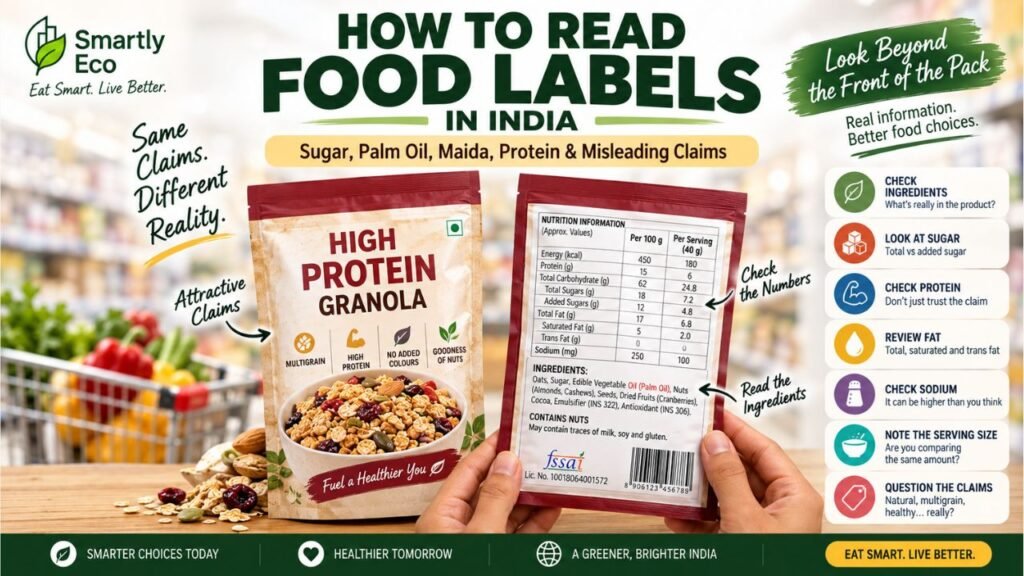
When you’re standing in a supermarket aisle, check the packet in this order:
1. Check the ingredient list
Find out what the product is actually made from.
2. Look at the serving size
A product may advertise nutrition per serving while the packet contains several servings.
3. Check protein
Especially if the product is marketed as high protein.
4. Check total sugar and added sugar
“Total sugar” and “added sugar” are not the same thing.
5. Check saturated fat and trans fat
Particularly in biscuits, bakery products, snacks and desserts.
6. Check sodium
This can be surprisingly high in savoury packaged foods.
7. Then look at the marketing claims
Don’t let “natural,” “multigrain,” “fitness,” or “healthy” make the decision for you.
1. Start With the Ingredient List — Not the Front of the Packet
This is probably the most useful habit you can develop. Under FSSAI’s labelling regulations, ingredients in a multi-ingredient packaged food are generally listed in descending order of their composition by weight or volume at the time of manufacture.
In simple terms:
Ingredients appearing earlier generally make up more of the product than ingredients appearing later.
Example
Imagine a breakfast cereal whose ingredient list starts with:
Wheat flour → sugar → edible oil → cocoa → nuts
You shouldn’t judge the product simply because the front says:
“With nuts & cocoa.”
The ingredient list gives you a much clearer picture of what dominates the formulation.
Smartly Eco rule:
Read the first 3–5 ingredients.
You don’t necessarily need to understand every technical ingredient name. First understand what the product is primarily made from.
2. What About Sugar?
This is where food labels can become confusing.
You may see:
- Total sugars
- Added sugars
- Naturally occurring sugars
These are not interchangeable. FSSAI’s current labelling regulations distinguish between sugars and added sugars in nutritional information.
Total sugar
This includes sugars present in the food. For example, milk naturally contains lactose.
Added sugar
This refers to sugars added to foods or beverages. Examples can include:
- Sucrose
- Glucose
- Fructose
- Syrups
- Other added sugar ingredients
So don’t automatically assume:
“Sugar = added sugar.”
Look at the added sugar figure when it is provided.
3. Don’t Just Look for the Word “Sugar”
Sugar can appear under different names. Depending on the formulation, you may see ingredients such as:
- Sugar
- Glucose syrup
- Fructose
- Dextrose
- Maltose
- Invert sugar syrup
- Honey
- Jaggery
But here’s an important distinction: An ingredient having a different name doesn’t automatically make it healthier or unhealthier. Honey and jaggery still contribute sugars.
So don’t fall into the trap of:
“It doesn’t say sugar, therefore it is sugar-free.”
Instead, look at the nutrition panel, particularly total sugars and added sugars.
4. “No Added Sugar” Does Not Mean “Sugar-Free”
This is an important distinction. A product can contain naturally occurring sugars without having sugar added during formulation. For example, dairy products can contain naturally occurring lactose.
So:
No added sugar ≠ zero sugar
Always check the nutrition table. And remember that a “no added sugar” product can still contain considerable calories from other carbohydrates or fats.
5. What Does “High Protein” Actually Mean?
The phrase “high protein” shouldn’t simply be treated as a marketing adjective. FSSAI regulates nutrient-content claims. Its Advertising and Claims regulations specify conditions for claims such as “high” or “rich” in protein.
That means when you see:
HIGH PROTEIN
don’t stop there.
Ask:
How much protein is actually in one serving?
For example:
Product A
20g protein / 100g
but serving size = 20g
Actual protein from one serving = 4g
That may be very different from what the large “HIGH PROTEIN” text on the front initially made you expect.
Smartly Eco rule:
Ignore the claim for 10 seconds. Read the grams.
Numbers beat adjectives.
6. Always Check Protein Per Serving
This is especially important with:
- Protein bars
- Breakfast cereals
- Granola
- Protein snacks
- Flavoured dairy products
- Packaged drinks
- Ready-to-eat foods
Suppose a product says:
Protein: 10g per serving
Sounds good. But then you notice:
Serving size: 50g
Now compare that with another product providing:
8g protein per 30g
The second product actually provides more protein per gram of product. This is why comparing products on the same basis can be useful.
FSSAI’s labelling framework requires nutrition information to be provided per 100g/100ml or per single-consumption pack, along with serving-related information.
7. Why “Per 100g” Is Useful
When comparing two similar products, per 100g gives you a common reference point.
For example:
| Product | Protein / 100g | Serving | Protein / serving |
|---|---|---|---|
| A | 20g | 30g | 6g |
| B | 15g | 50g | 7.5g |
Product A has more protein per 100g. But Product B gives more protein in the stated serving. That’s why you should look at both.
8. Palm Oil: Should You Automatically Avoid It?
Palm oil is one of the ingredients people are often told to fear. But the smarter approach is to understand the whole product.
Seeing:
Palm oil
on an ingredient list doesn’t automatically tell you that the entire product is unhealthy.
What matters is:
- How much of the food you eat
- Total fat
- Saturated fat
- Overall calorie content
- The rest of the ingredient list
- How frequently you consume the product
For example, biscuits, cookies and many bakery snacks may contain palm oil along with refined flour and sugar. In that situation, focusing only on the palm oil misses the bigger picture.
Better question:
What does this entire product look like nutritionally?
9. Maida: Look for the Actual Ingredient
“Made with whole grains” doesn’t necessarily mean the product contains only whole grains.
Look at the ingredient list.
You may find ingredients such as:
- Refined wheat flour
- Whole wheat flour
- Oats
- Rice flour
- Maize
- Other grains
If refined wheat flour appears near the beginning of the ingredient list, it may make up a significant part of the formulation. Again, don’t judge a product from the word:
MULTIGRAIN
on the front. Check the actual ingredient list.
10. “Multigrain” Doesn’t Automatically Mean “100% Whole Grain”
These terms are not necessarily equivalent.
Multigrain
Generally indicates that multiple grains are used.
Whole grain
Refers to grain containing its key anatomical components, including the bran, germ and endosperm. A product can therefore be:
multigrain without being entirely whole grain.
So if your goal is to increase whole-grain intake, don’t stop at the word multigrain. Read the ingredients.
11. “Natural” Is Not a Nutrition Score
Words such as:
- Natural
- Traditional
- Pure
- Real
- Wholesome
- Homemade-style
can influence how we perceive a product. But they don’t replace the nutrition panel.
FSSAI’s regulations specifically require food labels not to be presented in a false, misleading or deceptive manner.
So when you see:
“Made with natural ingredients”
ask:
What ingredients? And then turn the packet around.
12. Check Calories — But Don’t Judge a Food by Calories Alone
Calories matter, but they are only one part of the label. A 200-calorie food could be:
- A nutrient-dense snack
- A sugary dessert
- A protein-rich food
- A handful of nuts
The number alone doesn’t tell you the whole story.
Look at calories alongside:
Protein + fibre + sugar + fat + sodium + serving size.
13. Saturated Fat and Trans Fat Matter
FSSAI’s current nutrition-labelling framework includes:
- Total fat
- Saturated fat
- Trans fat
- Cholesterol, where applicable
- Sodium
alongside other nutrition information. This is particularly useful when comparing:
- Biscuits
- Cakes
- Cookies
- Bakery products
- Fried snacks
- Instant foods
- Desserts
Don’t assume that a product labelled “baked” or “light” automatically has a favourable fat profile. Read the numbers.
14. Don’t Forget Sodium
Salt isn’t the only way to think about sodium. The nutrition panel generally reports sodium in milligrams. Packaged foods that can contribute substantial sodium include:
- Instant noodles
- Chips
- Namkeen
- Sauces
- Ready-to-eat meals
- Processed savoury snacks
If you’re comparing two similar products, sodium can be another useful number to check.
15. Serving Size Can Completely Change the Story
This is one of the biggest label-reading traps. Imagine a snack packet contains:
5 servings
and the nutrition panel gives:
150 calories per serving
Eating the whole packet means:
150 × 5 = 750 calories
The same applies to sugar, fat, sodium and protein.
Always ask:
How much of this food am I actually going to eat?
FSSAI defines serving size as the amount customarily consumed per eating occasion or as defined on the label, with the amount expressed in metric units and potentially common household measures.
16. What About the Green Vegetarian Symbol?
For vegetarian packaged food in India, FSSAI’s regulations prescribe a green symbol for vegetarian foods. Non-vegetarian foods use a different symbol.
So if you’re specifically looking for vegetarian products, this is one of the quickest things to check. But remember:
Vegetarian ≠ automatically healthy.
A vegetarian biscuit, sugary cereal or fried snack is still a packaged food that should be evaluated by its ingredients and nutrition.
17. What About the FSSAI Logo and License Number?
The FSSAI logo and licence number are also part of the labelling requirements for packaged foods. But don’t make this mistake:
“It has an FSSAI number, therefore it must be healthy.”
That’s not what the licence means. Food safety regulation and nutritional quality are two different questions.
Think of it as:
FSSAI compliance → regulatory requirement
Nutrition quality → something you still need to evaluate
18. Don’t Be Scared by Every Long Ingredient List
A long ingredient list isn’t automatically proof that a food is unhealthy. Likewise, a short ingredient list isn’t automatically proof that it’s healthy. Some foods naturally require several ingredients.
Instead, ask:
What are the main ingredients?
How much sugar is present?
How much protein?
How much saturated fat?
How much sodium?
How large is the serving?
How often am I eating this?
That’s a much more useful approach than simply counting ingredients.
The 30-Second Food Label Test
Next time you’re shopping, use this:
STEP 1 — Flip the packet
Don’t decide from the front.
STEP 2 — Read the first 3–5 ingredients
What actually dominates the product?
STEP 3 — Check serving size
How much is one serving?
STEP 4 — Check protein
Especially if the product claims to be high-protein.
STEP 5 — Check added sugar
Don’t rely only on words like “natural” or “jaggery.”
STEP 6 — Check saturated fat
Particularly for snacks and bakery products.
STEP 7 — Check sodium
Especially for savoury packaged foods.
STEP 8 — Compare similar products
Use per-100g values where possible.
That’s it. You don’t need a nutrition degree to make a better supermarket decision.
Practical Label-Reading Example: Let’s Read a Packet Together
Knowing the rules is useful. But here’s what label reading actually looks like when you’re standing in a supermarket. Imagine you’re choosing between two packaged breakfast granolas.
Product A — “High Protein Granola”
Front of pack says:
HIGH PROTEIN
MULTIGRAIN
NO ARTIFICIAL COLOURS
Sounds impressive. Now turn the packet around.
Nutrition information
| Nutrient | Per 100g | Per serving (40g) |
|---|---|---|
| Energy | 450 kcal | 180 kcal |
| Protein | 15g | 6g |
| Total sugars | 18g | 7.2g |
| Total fat | 17g | 6.8g |
| Saturated fat | 5g | 2g |
| Sodium | 250mg | 100mg |
Ingredient list
Oats → sugar → edible vegetable oil → nuts → seeds → other ingredients
Now the picture is clearer. The product really does contain protein, but one 40g serving provides only 6g protein.
If you bought it specifically because the front says “HIGH PROTEIN,” the back tells you something much more useful: how much protein you’re actually getting in the amount you’re likely to eat.
Product B — “Whole Grain Oat Cereal”
Now imagine a second product.
Nutrition information
| Nutrient | Per 100g | Per serving (40g) |
|---|---|---|
| Energy | 370 kcal | 148 kcal |
| Protein | 12g | 4.8g |
| Total sugars | 6g | 2.4g |
| Total fat | 6g | 2.4g |
| Saturated fat | 1.5g | 0.6g |
| Sodium | 180mg | 72mg |
Ingredient list
Whole oats → whole wheat → nuts → seeds → other ingredients
Now you have a much better basis for comparison.
Product A has more protein per 100g, but it also has considerably more sugar and saturated fat in this hypothetical example.
Product B has less protein but a different overall nutritional profile.
So which one should you buy?
There isn’t a universal answer. It depends on what you’re looking for, how much you eat, what the rest of your diet looks like and how frequently you consume the product.
That’s the point of reading the label.
The label doesn’t tell you which food is “good” or “bad.” It gives you information so you can make the decision based on your own priorities.
Now Apply the 5-Question Test
Before putting either packet into your shopping cart, ask:
1. What are the first few ingredients?
Product A starts with oats, but sugar and oil appear immediately after.
Product B starts with whole oats and whole wheat.
Advantage: Product B, if whole grains are your priority.
2. How much protein do I actually get?
Product A: 15g/100g → 6g per 40g serving
Product B: 12g/100g → 4.8g per 40g serving
Advantage: Product A for protein.
3. How much sugar am I getting?
Product A: 7.2g per serving
Product B: 2.4g per serving
Advantage: Product B in this example.
4. What happens if I eat more than one serving?
This is where serving size becomes important. If you eat two servings of Product A, you have consumed:
12g protein + 14.4g sugar + 360 kcal
The numbers on the packet haven’t changed.
Your portion did.
5. Does the product fit my actual goal?
If your main priority is increasing protein, Product A may look attractive. If you’re prioritising lower sugar and a different overall nutrient profile, Product B may appeal more. Neither decision should be made simply because one packet has larger words on the front.
Here’s the Bigger Lesson
Imagine you walked into the supermarket and only saw these two front labels:
PRODUCT A:
🟢 HIGH PROTEIN
🟢 MULTIGRAIN
🟢 NO ARTIFICIAL COLOURS
PRODUCT B:
🟢 WHOLE GRAIN
🟢 SIMPLE INGREDIENTS
You could easily assume Product A is automatically the healthier choice.
But after 30 seconds of label reading, you discover:
Product A: More protein, but also more sugar and saturated fat.
Product B: Less protein, but a different overall nutritional profile.
That’s why Smartly Eco’s rule is simple:
Don’t buy the claim. Read the numbers.
One Important Clarification
The products and nutrition figures in this example are hypothetical and are included only to demonstrate how to read a label. They are not claims about any specific brand or product.
For an actual purchase, always use the nutrition panel and ingredient list printed on the product you are considering.
What About “Sugar-Free”?
Be careful here. Sugar-free is a specific nutrition claim—not simply a synonym for “healthy.”
A sugar-free product may still contain:
- Calories
- Fat
- Refined starches
- Other carbohydrates
- Sweeteners
So don’t stop reading once you see:
SUGAR FREE
Continue to the nutrition table.
What About “Low Fat”?
Same principle. Removing fat doesn’t automatically make a product healthy. Sometimes a low-fat product may still contain considerable sugar or refined carbohydrates.
Ask:
What replaced the fat?
And then check the ingredient and nutrition panels.
What About “High Fibre”?
This can be a genuinely useful claim, but don’t let one nutrient become the entire decision.
A product can be high in fibre while also containing substantial:
- Sugar
- Sodium
- Calories
- Saturated fat
Look at the complete nutrition panel.
What About “Protein-Rich” Snacks?
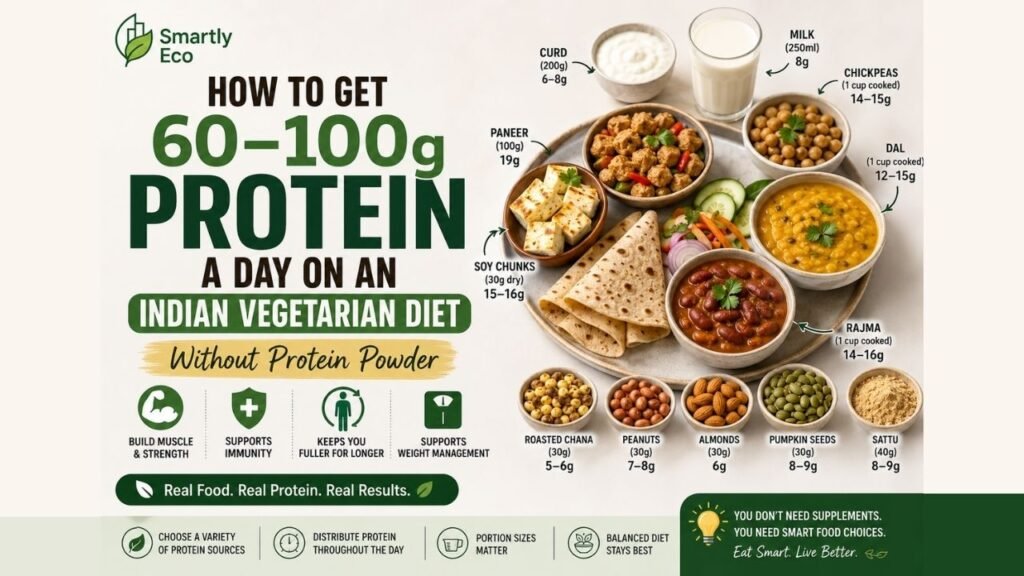
This is where your new protein knowledge becomes useful. If you’ve just read our guide on how to get 60–100g protein a day from an Indian vegetarian diet, you’ll know that protein can come from everyday foods such as dal, soy, paneer, curd, legumes, nuts and seeds.
That means a packaged food doesn’t automatically become a better choice just because it adds the words:
HIGH PROTEIN
Compare:
Product A: 12g protein + 20g added sugar
versus
Product B: 10g protein + 3g added sugar
The higher-protein product isn’t automatically the better everyday choice. Context matters.
The “Healthy” Product Checklist
Before putting a packaged food in your shopping cart, ask:
Ingredients
☐ What are the first few ingredients?
Sugar
☐ How much total sugar?
☐ How much added sugar?
Protein
☐ How much protein per 100g?
☐ How much per serving?
Fat
☐ How much total fat?
☐ How much saturated fat?
☐ What about trans fat?
Sodium
☐ Is sodium particularly high?
Serving
☐ How much is one serving?
☐ How many servings are in the packet?
Marketing
☐ Is the front making a health claim that the back doesn’t really support?
If you can answer those questions, you’re already a much more informed shopper.
One More Important Rule: Don’t Obsess Over a Single Ingredient
Nutrition isn’t a courtroom where one ingredient is either:
GOOD or BAD.
Palm oil doesn’t automatically make an entire food terrible. Sugar doesn’t automatically make every food unhealthy. Maida doesn’t mean you can never eat the product. An additive isn’t automatically dangerous simply because its name sounds complicated. And “natural” doesn’t automatically mean nutritious.
Your overall dietary pattern, portion size and frequency of consumption matter.
This is also why our existing Fake Healthy Foods guide can be useful as a companion read—but always prioritize the actual ingredient and nutrition information on the product you’re buying.
The Smartly Eco Label-Reading Formula
Remember this:
FLIP → READ → COMPARE → DECIDE
FLIP
Turn the packet around.
READ
Ingredients + nutrition table.
COMPARE
Serving size + per-100g values.
DECIDE
Then—and only then—look at the front-of-pack claims again.
You might be surprised how often your decision changes.
Frequently Asked Questions
What should I look at first on a food label?
Start with the ingredient list, then check serving size and the nutrition panel. The first few ingredients can tell you what makes up a large portion of a multi-ingredient product.
How do I know if a product has too much sugar?
Check both total sugars and added sugars where provided. Then consider the amount you’re actually eating rather than looking only at the number per 100g.
Is palm oil automatically unhealthy?
No single ingredient should be used as the sole measure of a product’s nutritional quality. Look at the product’s overall fat profile, calories, sugar, sodium and how frequently you consume it.
Does multigrain mean whole grain?
Not necessarily. “Multigrain” indicates multiple grains may be used; it doesn’t automatically mean the product is made entirely from whole grains.
Is high-protein food always healthy?
No. Check the actual protein quantity alongside sugar, saturated fat, sodium, calories and ingredients.
Is “no added sugar” the same as sugar-free?
No. A product can contain naturally occurring sugars while having no added sugar.
Should I avoid every food with a long ingredient list?
No. Ingredient-list length alone isn’t a reliable measure of nutritional quality. Look at the ingredients themselves and the nutrition panel.
Does an FSSAI licence mean a product is healthy?
No. FSSAI labelling and licensing requirements are regulatory requirements. They don’t mean that a product is automatically the healthiest choice.
Final Takeaway
You don’t need to become a nutrition expert to shop smarter. You just need to stop making your decision from the front of the packet.
Next time you see:
HIGH PROTEIN
NO ADDED SUGAR
MULTIGRAIN
NATURAL
LOW FAT
or
WHOLESOME
pause.
Turn the packet around. Read the ingredients. Check the serving size. Look at the actual numbers.
Then decide. Because the healthiest-looking packet isn’t necessarily the healthiest choice. The label tells you more than the marketing does.
Sources
- FSSAI — Food Safety and Standards (Labelling and Display) Regulations, 2020, current compendium
- FSSAI — Food Safety and Standards (Advertising and Claims) Regulations, 2018
- FSSAI — Food Laws & Regulations
Internal links used:
- How to Get 60–100g Protein a Day on an Indian Vegetarian Diet — from the high-protein section.
- Fake Healthy Foods: Why Marketing Tricks You — from the marketing/packaged-food section.
Editorial note: FSSAI regulations and product formulations can change. Readers should use the label on the product they are actually purchasing as the final source for its nutrition information.

Nikita Palesha is a wellness writer and co-founder of Smartly Eco, focused on nutrition, natural health, and sustainable urban living. She researches and simplifies evidence-based health practices for everyday Indians — from managing vitamin deficiencies and thyroid health to building chemical-free skincare routines. Her writing draws on Ayurvedic principles, modern nutrition science, and a belief that the most effective health choices are also the most affordable.