
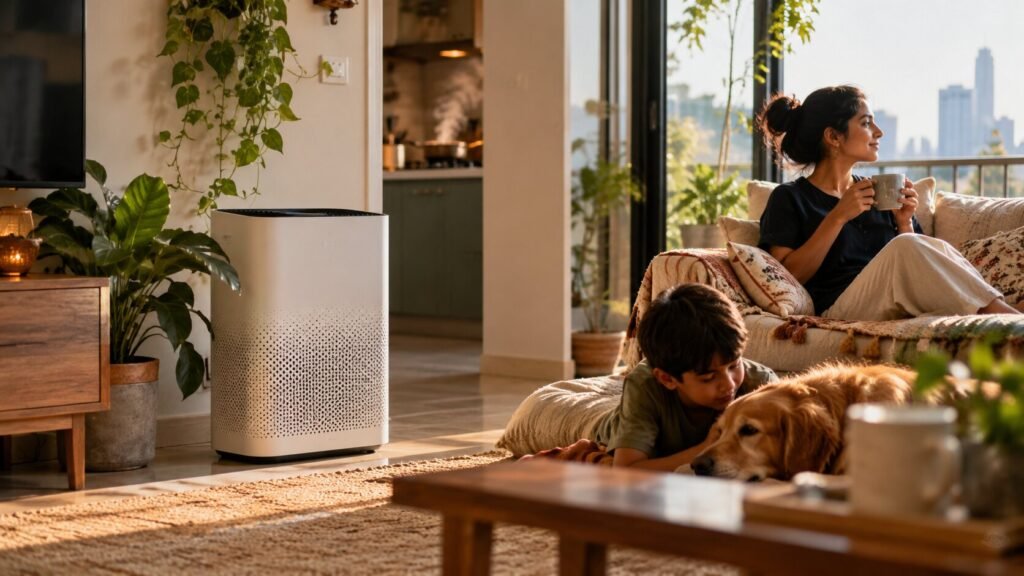
You clean your home, open the windows for some fresh air, and perhaps light an agarbatti to make the room feel pleasant. Yet, dust settles on the furniture again, traffic noise drifts in from outside, and the air can sometimes feel stuffy even when the room looks spotless.
Sound familiar?
Indoor air quality is easy to overlook because most pollutants are invisible. Dust, pollen, smoke, fine particles from outdoor pollution, and emissions from cooking can all affect the air inside your home. In many Indian cities, outdoor pollution can also enter through windows, doors, and ventilation openings.
An air purifier can help reduce certain airborne pollutants, but choosing one isn’t as simple as picking the most expensive model or the one with the highest number of features.
You need to understand what an air purifier can do, which specifications matter, and how well a particular model suits your room, household, and budget.
This guide explains how to choose an air purifier for your home in India without getting lost in technical jargon or marketing claims.
1. First, Understand Why You Need an Air Purifier
Before comparing brands, identify the problem you want to address. Different air purifiers use different filtration technologies, and no single model is equally effective against every type of pollutant.
Common indoor air-quality concerns include:
- Dust and fine particles: These may enter from outdoors or become airborne during cleaning, movement, and everyday household activities.
- Outdoor air pollution: Fine particles from traffic, construction, and other sources can enter homes through openings and ventilation systems.
- Cooking emissions: Frying, tadka, grilling, and other cooking activities can release particles into the air. Using appropriate ventilation, such as an exhaust fan or a properly vented range hood, is an important first step.
- Pollen and other allergens: These can enter from outdoors and circulate indoors.
- Smoke and odours: Smoke and some odours may require different filtration methods, depending on their composition.
Cooking habits can influence what enters your indoor environment. If you’re interested in making more informed choices in the kitchen, read our guide to the cooking oil truth no Indian kitchen talks about.
The important point: An air purifier should address your actual concern. Don’t pay extra for features you don’t need, and don’t assume that one machine can eliminate every indoor pollutant.
For a broader overview of indoor air pollution and filtration, the US Environmental Protection Agency offers a useful guide to air cleaners in the home.
2. Choose the Right Filter: HEPA, Activated Carbon and More
Filters are at the heart of most air purifiers. Understanding the difference between them helps you avoid paying for features that don’t address your needs.
HEPA filters: For airborne particles
A high-efficiency particulate air (HEPA) filter is designed to capture airborne particles, including many fine particles, pollen, and other particulate pollutants.
A commonly cited HEPA benchmark is the ability to remove at least 99.97% of particles measuring 0.3 micrometres under specified test conditions. This is a filter-performance benchmark, not a guarantee that a purifier will remove the same percentage of pollutants from your entire room.
Actual room performance depends on several factors, including the purifier’s airflow, room size, filter condition, placement, and how much polluted air continues to enter the space.
What to look for: Check the exact filter specification and the manufacturer’s documentation. Don’t assume that every filter described as “HEPA-type,” “HEPA-like,” or “high efficiency” meets the same standard as a true HEPA filter.
Activated carbon filters: For certain gases and odours
Activated carbon can adsorb certain gases and odour-causing compounds. It may be useful if cooking smells or other gaseous pollutants are a concern.
However, carbon filters vary significantly in their effectiveness. A thin carbon-coated sheet may not perform like a filter containing a substantial quantity of activated carbon.
Activated carbon also has a limited capacity. Its performance can decline as it becomes saturated, and not every gas is effectively removed by every carbon filter.
What to look for: Check whether the manufacturer provides meaningful information about the carbon filter and the pollutants it is designed to address.
Pre-filters: For larger particles
Many air purifiers include a pre-filter designed to capture larger particles, such as hair, lint, and visible dust.
A pre-filter can help protect the main filter and may be washable, depending on the model. However, a washable pre-filter is not a substitute for the main particle filter.
What to look for: Check whether the pre-filter is removable and how frequently it needs cleaning.
UV-C, ionisers and other additional technologies
Some models advertise UV-C lights, ionisers, plasma technology, or other purification features.
These technologies should not automatically be treated as proof of better performance. Their effectiveness depends on the technology, design, exposure conditions, and pollutants being targeted.
Be particularly cautious with devices that intentionally generate ozone. Ozone can irritate the lungs, and the EPA advises against using ozone generators in occupied spaces as air cleaners.
Read the EPA’s explanation of ozone generators sold as air cleaners before considering such products.
A practical starting point for most households: Look for a purifier with a well-specified particle filter, adequate clean-air delivery, and replacement filters that you can reasonably afford.
3. Match the Purifier to Your Room Size
One of the most common buying mistakes is choosing a purifier based on its appearance, brand reputation, or advertised features without checking whether it can clean the air in the intended room.
A purifier suitable for a small bedroom may be inadequate for a large living room.
Two specifications can help you make a more informed decision: CADR and air changes per hour.
What is CADR?
CADR stands for Clean Air Delivery Rate. It indicates how quickly a purifier delivers filtered air under specified testing conditions.
A higher CADR generally means the purifier can clean a larger volume of air more quickly.
For a practical comparison, check that the CADR rating is measured using a recognised method and that you’re comparing similar specifications across models.
How to estimate the CADR you need
For a rough estimate, you can use this formula:
Required CADR (m³/h) = Room volume (m³) × Desired air changes per hour
Room volume is calculated as:
Room volume = Length × Width × Height
Let’s take a typical Indian bedroom measuring 12 feet × 12 feet, with a ceiling height of 10 feet.
First, calculate the room volume:
12 × 12 × 10 = 1,440 cubic feet
Converting this to cubic metres gives approximately 40.8 m³.
Suppose you want the equivalent of five air changes per hour:
40.8 × 5 = 204 m³/h
This gives a rough target of around 204 m³/h of clean-air delivery.
This is an estimate rather than a universal recommendation. The appropriate target depends on your air-quality concerns, outdoor pollution levels, room conditions, and how the purifier is used.
For a larger room, or a space with significant particle pollution, you may need a higher CADR.
What about air changes per hour?
Air changes per hour (ACH) describes how many room-volumes of air a system can deliver as clean air in one hour.
For example, five equivalent air changes per hour means the purifier delivers a quantity of filtered air equal to five times the room’s volume every hour.
This doesn’t mean that every particle in the room disappears after one air change. Air mixes imperfectly, pollutants continue to enter, and the purifier’s actual performance depends on how air moves through the room.
Buying tip: Measure the room where you’ll use the purifier most often. Don’t choose a model based only on the total square footage of your entire home if you plan to move it between rooms.
4. Understand India’s Indoor and Outdoor Air-Pollution Conditions
Air-quality needs can vary considerably across India.
A home near a busy road, a construction site, or an area with frequent dust may face different challenges from a home in a quieter neighbourhood. Seasonal conditions can also influence outdoor pollution and the amount of time windows remain open.
The World Health Organization’s air-pollution resources explain why air pollution is an important public-health concern.
For Indian outdoor air-quality information, you can also check the Central Pollution Control Board’s National Air Quality Index.
Remember that an outdoor AQI reading doesn’t tell you exactly what the air quality is inside your home. Indoor pollution also depends on cooking, cleaning, ventilation, household activities, and the movement of outdoor air indoors.
Air pollution is part of the broader conversation about urban living and wellbeing. Explore our guide to anti-aging habits for city living for another perspective on everyday environmental factors.
Should you run an air purifier all day?
It depends on your circumstances, the purifier’s operating cost, and the pollution levels in your home.
Running a suitable purifier for longer periods can help maintain lower airborne-particle concentrations, provided the unit is correctly sized and maintained. Many models offer an automatic mode that adjusts fan speed based on their built-in sensors.
However, an automatic mode is not a guarantee that every pollutant is being measured or controlled. Most consumer air-quality sensors focus on particular types of particles, and readings may not reflect gases or every source of indoor pollution.
If outdoor pollution is high, keep windows and doors closed when practical while maintaining appropriate ventilation and indoor safety. If your home uses fuel-burning appliances, never compromise essential ventilation or ignore carbon monoxide safety to keep the room sealed.
5. Check the Running Cost Before You Buy
The purchase price is only part of the cost of owning an air purifier.
You’ll also need to consider electricity consumption, filter replacement, and routine maintenance.
A model that looks affordable initially may become expensive if its replacement filters cost a lot or need frequent replacement.
Calculate the electricity cost
You can estimate the cost of running an air purifier using this formula:
Monthly electricity cost = Power consumption (kW) × Hours of use per day × Days of use × Electricity tariff per kWh
Let’s assume:
- Average power consumption: 40 watts, or 0.04 kW
- Daily use: 12 hours
- Monthly use: 30 days
- Electricity tariff: ₹8 per unit
The calculation is:
0.04 × 12 × 30 × ₹8 = ₹115.20
The estimated electricity cost would be approximately ₹115 per month.
This is only an illustration. Actual consumption varies with fan speed, operating mode, and model, so use the manufacturer’s power specifications and your electricity tariff for a more accurate estimate.
Include replacement-filter costs
Before buying, check:
- The price of the replacement filter
- Whether replacement filters are readily available in India
- The manufacturer’s recommended replacement interval
- Whether the filter’s lifespan depends on operating hours or measured conditions
- Whether the purifier indicates when a filter needs replacing
- Whether cleaning the pre-filter is sufficient for routine maintenance or other parts require servicing
Don’t assume that a filter will last a full year simply because a listing advertises a long lifespan. Actual life depends on usage, pollution levels, and maintenance.
A useful rule: Compare the estimated cost of ownership over two or three years, not just the initial purchase price.
6. Don’t Be Distracted by Every Feature
Air purifiers increasingly come with app connectivity, voice control, touchscreens, air-quality displays, and automatic modes.
Some features are genuinely useful. Others may not make much difference to your daily experience.
Here’s how to assess common features.
| Feature | Is it useful? | What to check |
|---|---|---|
| PM2.5 display | Can help you observe changes in measured particle levels | Sensor quality, placement, and what the display actually measures |
| Automatic mode | Can adjust fan speed based on sensor readings | Which pollutants the sensor detects and how the mode responds |
| Sleep mode | Can reduce noise and display brightness at night | Whether airflow remains adequate for your room |
| App connectivity | Useful for remote control and monitoring | Whether the app is reliable and the feature is worth the extra cost |
| Filter replacement indicator | A helpful maintenance reminder | Whether it uses a timer, operating hours, or actual filter-condition data |
| Washable pre-filter | Can reduce routine maintenance costs | Whether the manufacturer permits washing and how it should be cleaned |
| Child lock | Useful in households with young children | Whether the controls can be locked securely |
A simple model with strong filtration and sufficient clean-air delivery may be a better purchase than an expensive model packed with features you rarely use.
Also remember that a particle sensor reading is not a complete measurement of indoor air quality. A low PM2.5 reading does not necessarily mean that gases, odours, or every other pollutant are absent.
7. Common Air-Purifier Buying Mistakes to Avoid
Before making your purchase, watch out for these common mistakes.
Mistake 1: Buying based only on the advertised room size
Manufacturers may specify coverage under particular conditions. Check the CADR and consider the room’s actual dimensions rather than relying on a broad coverage claim alone.
Mistake 2: Assuming every HEPA-labelled filter is equivalent
Filter descriptions can differ. Check the exact specification and supporting documentation rather than relying on a prominent word on the packaging.
Mistake 3: Ignoring replacement-filter availability
A purifier becomes less useful if you cannot find compatible filters when needed. Check replacement costs and availability before buying.
Mistake 4: Expecting an air purifier to solve every air-quality problem
Particle filters can capture airborne particles, while activated carbon may help with certain gases and odours. Neither should be assumed to remove every pollutant.
An air purifier also doesn’t replace kitchen exhaust ventilation, dampness control, source reduction, or appropriate ventilation when required.
Mistake 5: Paying extra for unsupported health claims
Be cautious of claims that a device can eliminate every toxin, guarantee protection against illness, or provide complete protection from outdoor pollution.
Look for clear performance specifications and credible evidence instead.
Smart purchasing starts with understanding what a product actually offers rather than relying on impressive marketing language. Our guide to reading food labels in India and identifying misleading claims explains the same principle in the context of everyday food choices.
Mistake 6: Forgetting where the purifier will be placed
An air purifier needs adequate airflow. Pushing it into a tight corner, blocking its air intake, or placing it behind furniture can interfere with its operation.
Always follow the manufacturer’s clearance and placement instructions.
8. Where Should You Place an Air Purifier at Home?
Placement can influence how effectively a purifier circulates air through a room.
For best results:
- Place the unit in the room where you spend the most time or where your air-quality concerns are greatest.
- Follow the manufacturer’s instructions for clearance around the air intake and outlet.
- Avoid blocking the purifier with curtains, furniture, or other objects.
- Keep doors and windows closed when practical if your aim is to reduce the entry of outdoor pollution.
- Avoid placing the unit directly beside a source of grease or heavy cooking emissions unless the manufacturer specifically recommends that use.
- Clean the pre-filter and replace filters according to the manufacturer’s instructions.
Should you buy one purifier for the whole house?
Not necessarily.
A portable purifier mainly treats the air that passes through it. Walls, closed doors, room layouts, and airflow patterns limit how effectively it can serve several rooms at once.
For many households, it makes sense to begin with the bedroom or another frequently occupied room. If you need filtration in several separate rooms, consider the requirements and running costs of each space before buying multiple units.
9. An Air Purifier Is Only One Part of Better Indoor Air Quality
Buying an air purifier is not the only way to improve the air inside your home.
A practical approach combines filtration with reducing pollution at its source.
Here are some useful habits:
Use appropriate kitchen ventilation. Cooking can release particles and gases. Use an exhaust fan or a properly vented range hood when possible, especially during frying and high-heat cooking.
Reduce unnecessary dust. Damp dusting and suitable vacuuming methods can help prevent settled dust from becoming airborne again.
Avoid indoor smoke where possible. Tobacco smoke, incense, candles, and other burning materials can release particles into the air.
Address dampness and mould. Repair leaks and manage excess moisture. A particle filter should not be treated as a substitute for fixing the source of a mould problem.
Ventilate thoughtfully. Outdoor air can help dilute some indoor pollutants when outdoor conditions are suitable. When outdoor pollution is high, consider local air-quality conditions and the ventilation needs of your home.
Maintain your purifier. A dirty pre-filter or overdue replacement filter can affect performance. Follow the manufacturer’s maintenance instructions.
Be careful with fragrance products. Air fresheners and scented products can introduce additional substances into indoor air. If you notice irritation or persistent odours, identify and address the source rather than simply masking it.
The broader lesson is that better indoor air quality comes from a combination of sensible habits, appropriate ventilation, source control, and filtration where needed.
10. Your Air-Purifier Buying Checklist
Before you place an order, run through this checklist.
- I know which room I want to clean.
- I’ve measured the room’s length, width, and height.
- I’ve checked the purifier’s CADR rather than relying only on its advertised coverage area.
- I’ve checked the filter specification and the pollutants it is designed to address.
- I’ve considered whether activated carbon is useful for my needs.
- I’ve checked the price and availability of replacement filters.
- I’ve estimated the electricity cost.
- I’ve checked noise levels, particularly for bedroom use.
- I’ve considered where the purifier will be placed.
- I’ve checked the manufacturer’s maintenance instructions.
- I’ve avoided relying on unsupported health claims or unnecessary features.
If you can answer these questions confidently, you’re in a much better position to choose a purifier that suits your home instead of paying for specifications you may never use.
Frequently Asked Questions
1. Which type of air purifier is best for Indian homes?
There is no single best model for every Indian home. For households concerned about airborne particles, a well-specified particle filter, adequate CADR for the room, and readily available replacement filters are important starting points. If odours or certain gases are also a concern, consider a model with an appropriate activated-carbon filter.
2. Is a HEPA filter necessary in an air purifier?
A well-specified HEPA filter can be a useful choice when the primary concern is airborne particles. However, the filter alone does not determine the purifier’s overall performance. Airflow, room size, filter condition, and the way the unit is used also matter.
3. How do I calculate the right CADR for my room?
Multiply the room’s length, width, and height to calculate its volume. Then multiply that volume by your desired equivalent air changes per hour.
For example, a room measuring approximately 40.8 m³ with a target of five equivalent air changes per hour would require a clean-air delivery rate of roughly 204 m³/h.
Use this as a starting estimate, not a guarantee of performance. Your actual needs may vary with pollution levels and room conditions.
4. Can an air purifier remove cooking smells?
A purifier with an appropriate activated-carbon filter may reduce some cooking odours. However, performance varies with the amount and type of carbon, the pollutant, and how quickly the filter becomes saturated.
Using appropriate kitchen ventilation and reducing the source of emissions remain important.
5. Should I keep my air purifier running all night?
You can use an air purifier overnight if the model is suitable for continuous operation and its noise level is comfortable. Make sure it is appropriately sized for the room and maintained according to the manufacturer’s instructions.
6. How often should I replace the filter?
Follow the manufacturer’s recommendations for your specific model. Replacement intervals vary depending on filter design, usage, and pollution levels. Check the filter regularly and don’t rely solely on a generic replacement schedule.
7. Can an air purifier replace opening windows?
No, not in every situation. An air purifier filters air that passes through it, but it does not automatically provide the ventilation needed in every home.
When outdoor air quality is good, ventilation can help dilute indoor pollutants. When outdoor pollution is high, you may need to limit the entry of polluted air while maintaining appropriate ventilation and essential safety requirements.
8. Are expensive air purifiers always better?
No. A higher price does not automatically mean better filtration or more suitable performance for your room.
Compare CADR, filter specifications, replacement-filter costs, noise levels, maintenance requirements, and credible performance information before making a decision.
Final Thoughts
Choosing an air purifier doesn’t need to be complicated.
Start by identifying your main concern, measuring the room, checking the CADR, and understanding what the filter can and cannot remove. Then compare electricity consumption, replacement-filter costs, noise levels, and maintenance requirements.
Most importantly, remember that an air purifier is a tool, not a complete solution to indoor air pollution. Combining suitable filtration with source control, sensible ventilation, and regular maintenance is a more practical way to manage indoor air quality.
The best purifier for your home is not necessarily the most expensive one. It’s the one that fits your room, addresses your actual needs, and remains effective and affordable to operate over time.

Komal Palesha is a health and lifestyle writer at Smartly Eco, specialising in fitness, natural beauty, and mindful nutrition for urban Indians. She covers topics ranging from celebrity fitness routines to traditional Indian remedies backed by modern science — translating complex wellness research into practical, actionable advice. Komal is committed to promoting health choices that are sustainable, affordable, and rooted in Indian culture.